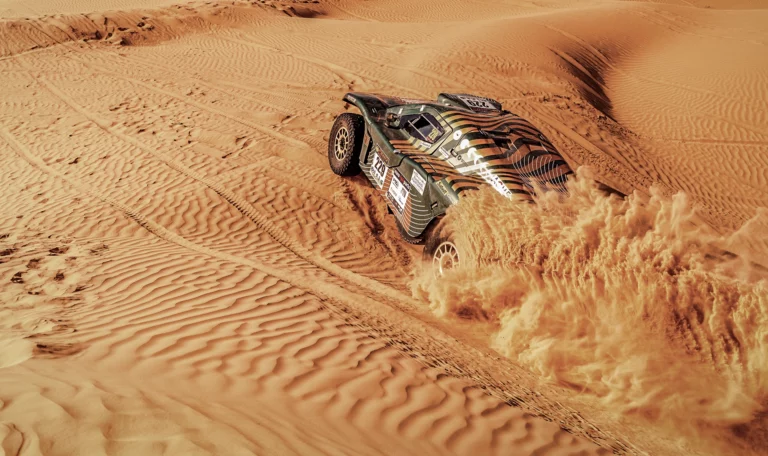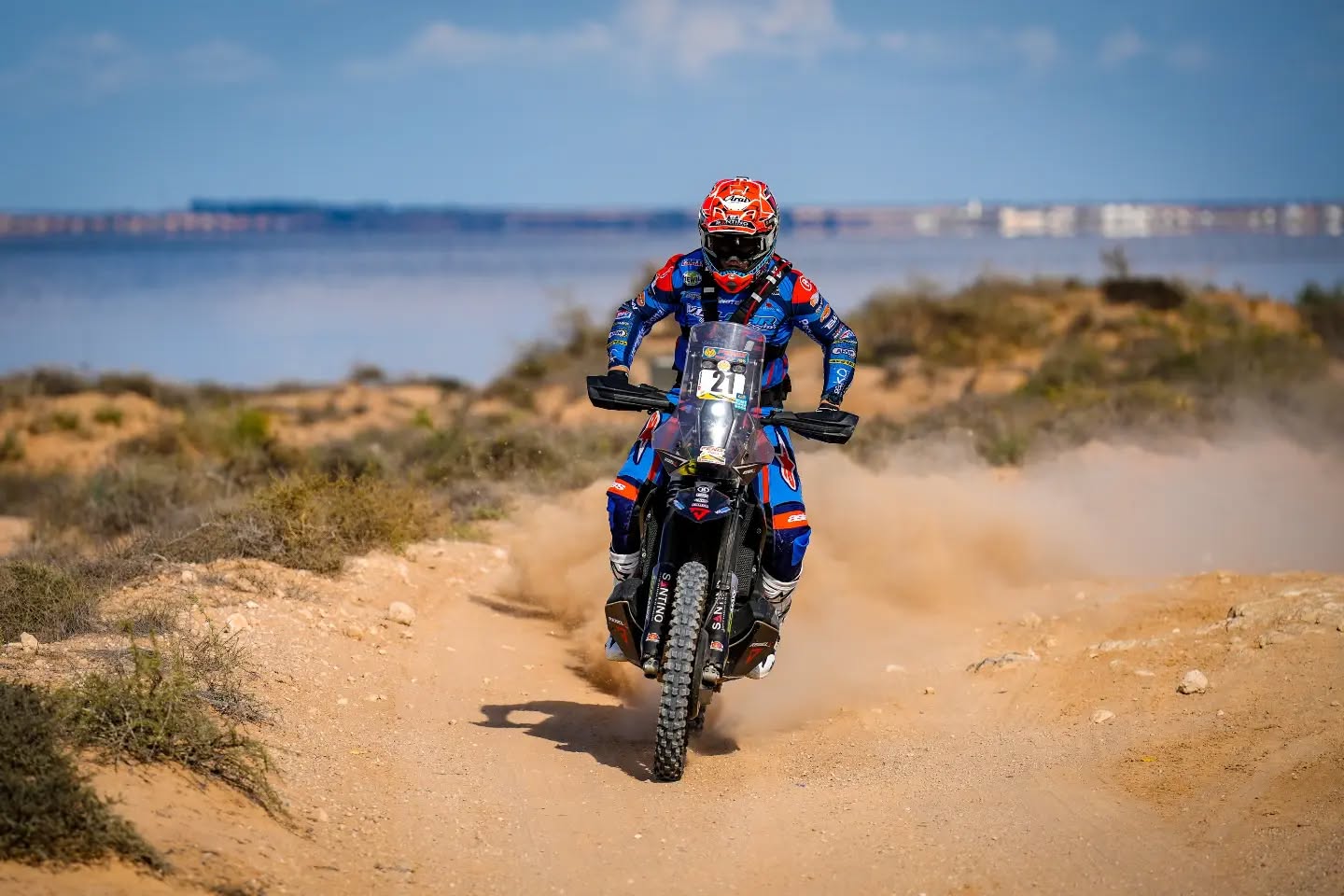

The Fenix Rally 2026 opened on Saturday afternoon on Djerba with a prologue of just over thirty kilometres across sandy and gravelly roads. Jeremy Knuiman was the fastest motorcyclist. Hugues Lacam and Delphine Delfino (MMP T3) were quickest among the SSVs, the class with the most entrants. In the cars, the best time went to Magdalena Zajac and Blazej Czekan (Toyota Hilux), but only after the organisers had processed the penalty minutes. The Belgian-Dutch pairing of Vincent Thijs and Arjan van Tiel (Toyota Hilux) had actually set the fastest time of the entire field, but received a thirty-minute penalty for a cut section of the route and a missed waypoint.
The prologue does not count towards the overall classification and only determines the starting order for today’s first stage. The speeding penalties did, however, leave a considerable mark on the results, especially among the motorcycles. These are provisional and unofficial results; the stewards may still make changes. With Knuiman and Daan Veenendaal in the top two places among the motorcycles, it was a good opening day for the Dutch. Henri van Steenbergen, who drives a GPR Oryx with Daan van Ooijen, finished 21st among the SSVs.
Motorcycles and quads: Dutch one-two
Knuiman (KTM EXC 450) was the fastest of the sixteen classified motorcyclists in 22:31.25. Veenendaal (GasGas 500) of the De Baar Rally Team finished second, 1:28.9 behind. Back in March, Knuiman already won the Rally2 prologue in Portugal on his first W2RC appearance. Today he gets to open the first real stage as the first rider. That is an advantage on tracks and dust, but he will have to find the route without anyone else’s tyre tracks.
Austrian Georg Reinprecht (Beta RR 390) finished third, 2:34.7 behind. He benefited from a forty-second speeding penalty handed to Richard Wijntjes (Husqvarna FE 501). Without that penalty the Dutchman would have been third; as it was, he finished fourth. German Justin Gerlach (KTM 450 Rally) ended up fifth, but deliberately took it easy so as not to have to start too early today. He also lost his windscreen along the way. “A rider overtook me and a flying stone hit the screen,” he said. After finishing, Gerlach removed the tanks to check the new engine for parts shaken loose. He found nothing.
Pascal de Baar (KTM EXC 525), a winner of Dakar stages as a truck driver in 2016 and 2023 and, as he often does, here riding a motorcycle for fun with friends, finished eighth, 5:26.6 behind. Dries de Baar (GasGas 450) is on the entry list but does not appear in the provisional results. The reason for this has not been disclosed. At the back of the field the penalties were hefty: five riders, including the two Algerians, received between 16 and 49 minutes of penalties for speeding in restricted zones.
Among the quads it was a Polish affair, as expected. Adam Krysiak (Polaris Scrambler) was 51 seconds quicker than Karol Slugocki.
SSV: Lacam ahead of Lafay and Martinez
Lacam was the fastest of all 46 SSV crews, and of the entire field after the penalties had been processed, in 19:34.74. Pierre Lafay, last year’s SSV winner in the Africa Eco Race, finished second with Loïc Minaudier (Can-Am Maverick R), 34.7 seconds behind. Nicolas Martinez and Lili Delfino (Overdrive OT3) came third, 41.5 seconds behind. That put two T3 prototypes in the top three. Finns Mikko Ikonen and Joni Lassila and Frenchmen Raoul Fenestraz and Lili-May Mansuy (both Can-Am X3) completed the top five. Eric Culus, third in last year’s final classification, finished eleventh.
André Thewessen and Jeffrey Spoor (Can-Am Maverick R) were the best Dutch crew in sixth, 1:39.5 behind Lacam. They managed that despite a messy build-up. According to navigator Spoor, his tablet broke just before the start, though they made it to the line on time with a replacement. They also lost some time along the way when they tried to overtake a slower entrant and the Sentinel, the warning system between vehicles, turned out not to be working either. As a precaution, the team carried out maintenance afterwards so the pairing can “head out carefree again”. The Belgian Can-Am outfit Art of Speed had its best crew in seventh with Hans den Ouden and Dirk Goris.
Cars: Zajac profits, Feryn and Wauters straight into the mix
Thijs and Van Tiel completed the prologue in 16:35.97. That was almost three minutes faster than Lacam and well over four minutes faster than Zajac. In the end, however, they finished twelfth of the fourteen cars, 26 minutes behind the winner. The penalty stemmed from a cut section and a missed waypoint. Van Tiel took responsibility afterwards. “Drove the prologue badly. Because of my navigation error,” he said. According to him, the pairing went the wrong way and missed a waypoint as a result. The large gap to the rest of the field does raise the question of how much time the shortcut saved. The results provide no clarity on that. In any case, the upshot is that the highest-classified returnee from last year starts at the back of the car class today.
Zajac and Czekan took over the class in 20:20.97. According to Feryn Dakar Sport, the Polish pairing drives a T1+ version of the Hilux, more powerful than the Belgian team’s versions. Pascal Feryn and Kurt Keysers finished second, 36.2 seconds behind, including a ten-second speeding penalty. Koen Wauters and Tom De Leeuw followed 52 seconds back. Wauters started a minute ahead of his teammate. Feryn used that as a target: he took Wauters’ dust cloud as a reference point and drove “with the knife between his teeth”. At the finish he was fifteen seconds quicker. Wauters was back behind the wheel of the Toyota for the first time since the Africa Eco Race. He was satisfied with the gap to Zajac, who in his view drives more rallies and has a more modern car. Of his own car he said: “The car has so much torque that it always pulls you through.”
Belgians Vincent Vroninks and Dave Berghmans (Red-Lined VK56) finished fourth, with a two-minute penalty for a missed waypoint. Romanian Calin Camarasan (Ford Ranger) did not reach the finish. Thomas Jolliffe and Mark Foster of JB Equipment Racing finished ninth with their Land Rover Defender. On Saturday they drove their first real day in the new car, which according to the team feels “much faster than the old one”. The goal for this rally is to start every day and get to know the car better.
In the Limited class, Tunisians Karim Benhassan Krayem and Nouichi Mohamed Elmecano (Toyota LC79) were clearly the fastest, followed 3:54.5 behind by Austrians Ewald Holler and Markus Bodzenta (Toyota Land Cruiser).
Trucks
Among the trucks the fastest time went to Paolo Calabria, Loris Calubini and Carlos Alberto Viña (MAN TGA), second in the class last year. They were well over four minutes faster than the German crew of Stella Koerber (ÖAF Gräf & Stift).
The Dutch
Among the SSVs, the Dutch contingent after Thewessen remained largely in the second half of the field. Van Steenbergen and Van Ooijen finished 21st, 4:02.7 behind. Their OryxRallySport teammates, Daniel Kersbergen and Michiel Goegebeur, finished 26th. De Run Trading had a mixed day: Harrie van Empel and Stefan van Ras finished 25th, while Max and Sem van Empel received a two-minute penalty for a missed waypoint and ended up in 35th place. Coen Nooijen and Tijs Dijk finished 37th, partly due to a thirty-second speeding penalty. Rob van Horssen and Carlo Spreeuwenberg (34th, 2:20 penalty) and “Captain Slow” and Jan-Willem van Mourik (33rd, 20-second penalty) were also penalised for speeding offences. Arjan Donders and Edwin Vloemans finished 28th without penalty.
The hardest hit were Dick van Culenborg and Marius Bos. They received a one-hour time penalty for a speeding offence and brought up the rear of the SSV field in 1:24:19.
Loasis
In the Loasis L’Original, the rally-raid for historic vehicles running alongside the Fenix Rally, Jules Maufret with Antoine Paque in a Chevrolet was fastest in class 95, with a 3:18.4 lead over Jean-Michel Villot. Alain Coquelle and Louis Boilly Coquelle (Bowler) were fastest in the 2005 class, and Jean-Jacques Ganteaume and Ingrid Caster (Toyota) in the Open class. Here too penalties played a role: in the Safari class, Guillaume and Simon Combes received 34 minutes of penalties for four missed waypoints, which handed the fastest time to Enzo Donsimoni and Hugo Feugier. Among the historic motorcycles, all three riders in the M2005 class received a speeding penalty. Organiser Gilles Girousse did not start in the prologue.
Stage 1: from Djerba to Douz
Today the caravan leaves Djerba for the first stage to the bivouac in Douz. The day covers 434 kilometres, of which 252.89 kilometres are against the clock. The motorcycles start the special at 7:43 local time, the cars at 8:19. The opening is technical, with narrow paths, vegetation and passages through villages. After that the pace picks up, and from kilometre 98 comes a series of wadis in which choosing the right bed and exit is important. In Tataouine there is a neutralisation of one hour and fifteen minutes, during which motorcycles and quads must refuel; their range is around 150 kilometres. After the restart the terrain becomes more open and desert-like. From kilometre 176 come several dangerous passages, and from kilometre 220 the route runs through a sandy oued, according to the organisation one of the most navigation-sensitive parts of the day. After the finish there is still a 142-kilometre liaison to Douz.