
The Morocco Desert Challenge is set for a major overhaul in 2027. After sixteen years with Jean-Claude Kaket as race director, French navigator Sébastien Delaunay takes over race management and the roadbooks. He has drawn up a route of which, according to the organisation, roughly ninety percent consists of tracks that MDC competitors have never driven before. On top of that, the rally gains a vintage category with its own classification, and the roadbooks will from now on be built to the FIA standard.
Organiser Gert Duson presented the plans for the 8 to 17 April 2027 edition on 1 October at QFF, where Wil Theuws has for years hosted the Dutch presentation of the event. RallyTracks spoke with Duson afterwards.
Delaunay succeeds Kaket
The most important change is in race management. Jean-Claude Kaket was race director for some sixteen years and was already responsible for the roadbooks when the rally, back then still the Libya Rally, temporarily relocated to Tunisia. “Times change and you have to move with the times,” Duson said of the choice for Sébastien Delaunay.
Duson calls the Frenchman one of the best navigators in the world, with seventeen years of experience in the Dakar and in the rally-raid world championship. It should be noted here that the current World Rally-Raid Championship (W2RC) has only existed since 2022; before that, the FIA World Cup for Cross-Country Rallies was the highest international level. According to Duson, Delaunay also writes roadbooks for the factory teams.
Dutch rally enthusiasts know Delaunay mainly as Erik van Loon’s navigator. The pair drove the Dakar together in 2020, 2021 and 2023, among others, in a Toyota Hilux. In 2022 Delaunay was due to sit alongside Van Loon again in an Overdrive Hilux, but when the Brabant driver tested positive for covid shortly before the start, Bernhard ten Brinke took his place, with Delaunay as navigator. In 2019 the Frenchman drove the Dakar in a Peugeot 3008 DKR alongside Pierre Lafay.
Ninety percent unknown terrain
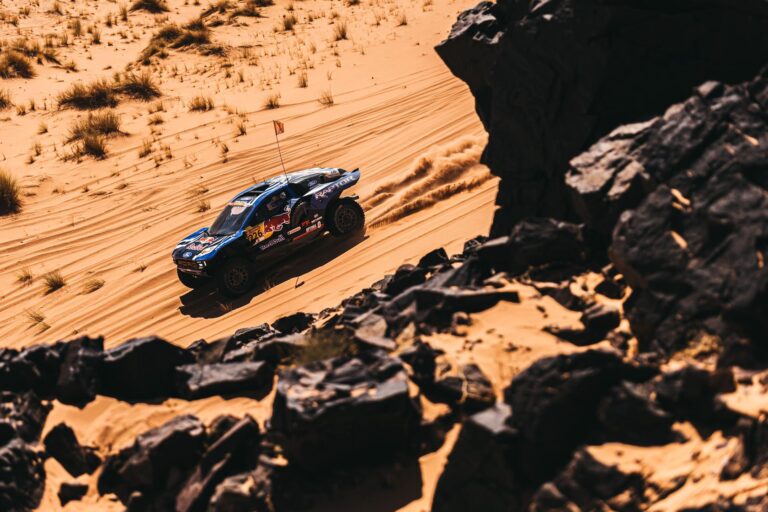
Duson gave Delaunay a clear brief: a route from Ouarzazate to Saïdia. He left the details to the new course director. When the new tracks were laid over those of recent editions, ninety percent turned out to be new for the MDC, according to Duson. That is striking, because in rally-raid circles Morocco is often seen as terrain that is by now known down to the metre. Delaunay reportedly promised Duson to take competitors to places where no one has been before, with new dune belts, canyons, riverbeds of some fifteen kilometres and landscapes reminiscent of Monument Valley.
The route starts, as in 2026, in Ouarzazate and runs via Oum El Hanch, Ksar Tiraf and Fezzou to Merzouga. After that the rally turns north, via Hassi El Aricha to the finish in Saïdia on the Mediterranean. The bivouac at Hotel Yasmina in Merzouga, a fixture for twelve years now according to Duson, is retained. All other bivouacs are new, even to Duson himself. “When I go to validate the roadbooks together with another navigator in February, it will be a discovery for me too,” he said.
That also means a sizeable part of the route will only be validated on the ground two months before the start. The ninety percent new tracks claim is, moreover, a comparison the organisation made itself; April will show how the new route works out in practice.
Navigation to the FIA standard
With Delaunay’s arrival, the MDC also takes a step towards professionalising navigation. All competitors in the Rally Pro category drive with ERTF’s GPS UNIK 4 digital roadbook system. What is new is that the roadbooks are built entirely to the FIA standard, including standardised waypoint types, symbols and notations. This brings the rally more closely in line with what competitors know from the W2RC and the Dakar.
Vintage: racing instead of regularity
Alongside a Malle Moto class, the organisation is introducing a vintage category. Elsewhere it is also called classic or historic, but “give the child a name,” Duson said. He had been toying with the idea for a while and listened to drivers with historic cars. Their objection: many rallies are too tough for cars whose suspension and shock absorbers were not built to withstand modern conditions.
Because Delaunay can adjust roadbooks quickly, the vintage competitors get their own variant of the course. The highest dunes and the toughest sections are taken out; according to Duson about ninety percent of their route is the same as that of the race. The class gets its own classification.
The big difference from many historic events is that it will not be a regularity run. According to Duson, regularity calls for its own kind of course director, because writing such a roadbook is a specialism in its own right. Moreover, many historic-car drivers actually want to be able to go all out for once instead of following an imposed schedule. “So it simply becomes a race, with a maximum speed of 140 kilometres per hour, but it is about being the fastest.”
The entry list promises to be varied. Two Volkswagen Beetles are entered, converted into rally cars but with original engines. Factory Mitsubishis that once drove the Dakar will also be at the start. According to the owner, five of them still exist, and all of them are taking part.
Dutchies again strongly represented
Duson is positive about the entries. Traditionally about half the field comes from the Netherlands and Flanders, with the Netherlands usually dominating. This time he counts ten race cars on the Flemish side alone, plus at least as many cars in the Raid class, and he expects more to come. Things are going well among the trucks too. De Rooy, which won the truck class this year with Kay Huzink, Mark Salomons and Corné Blok, has entered three trucks. In addition, Muller Truck Team and William van Groningen’s Rally Team Dust Warriors are taking part.
Anyone still wanting to enter at the reduced rate needs to be quick. Normally the early bird rate expired on 16 September, but because the Dutch presentation only took place on 1 October, the organisation has extended the deadline to midnight on Sunday 4 October.
The Morocco Desert Challenge 2027 takes place from 8 to 17 April, with the start in Ouarzazate and the finish in Saïdia.