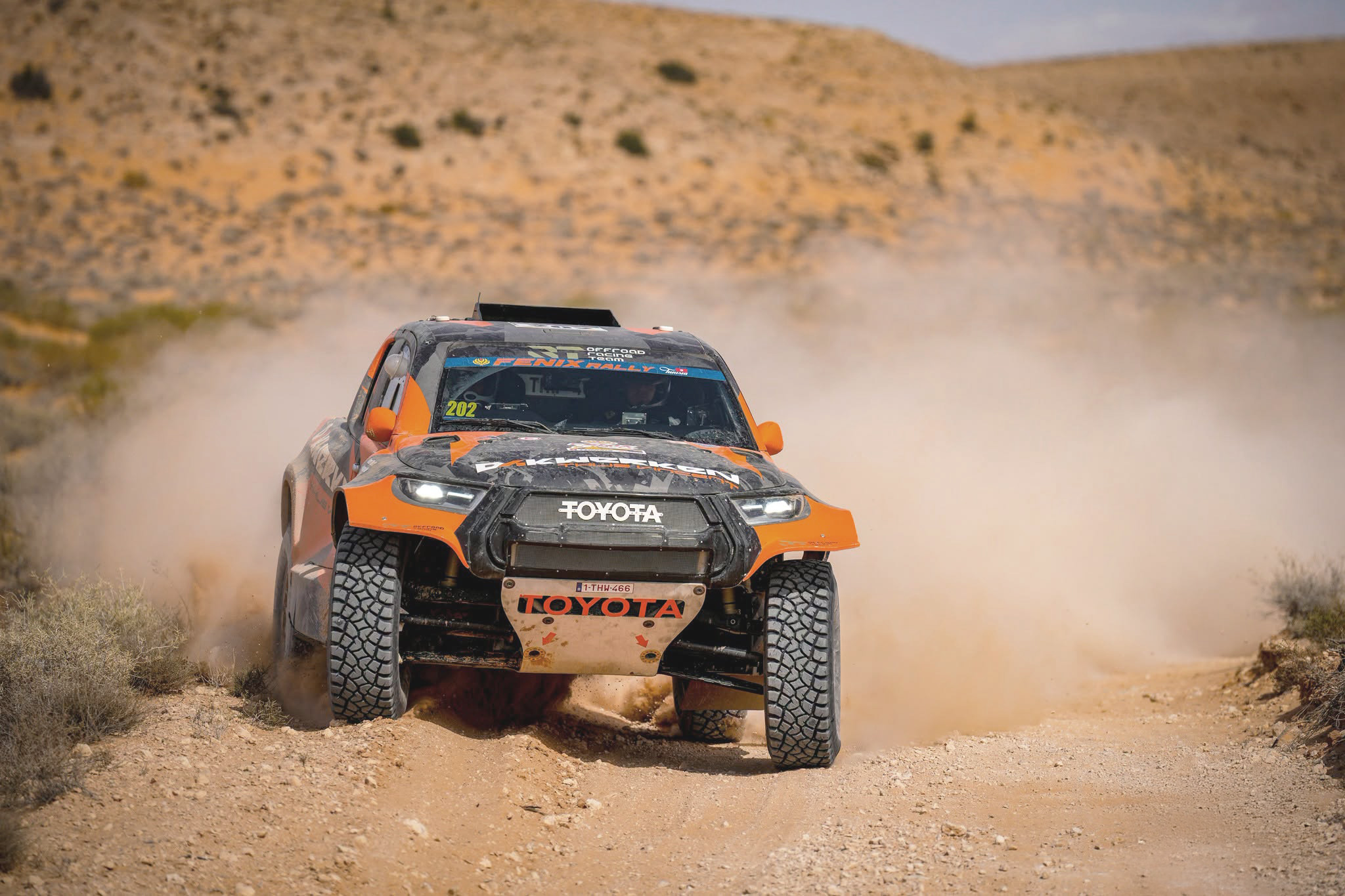

A day after their costly navigation error in the prologue, Vincent Thijs and Arjan van Tiel have claimed the first stage of the Fenix Rally. They completed the 252.89-kilometre special from Djerba to Douz in their Toyota in exactly 4 hours, the fastest time of the entire field. Among the bikes, German rider Justin Gerlach (KTM 450 Rally) won by more than six minutes over Jeremy Knuiman. In the SSVs, Frenchman Pierre Lafay was quickest. Because the prologue does not count, the result of this first stage also forms the first overall classification.
For the Dutch, it was a day of extremes. With Knuiman in second and Daan Veenendaal in third, two Dutch riders stand on the provisional bike podium. Among the SSVs, Max and Sem van Empel were the best Dutch crew in twelfth. André Thewessen and Jeffrey Spoor, still the best Dutch SSV crew on Saturday, lost more than two hours. The stage ran over fast gravel tracks, rugged rocky sections, riverbeds turned muddy by rain, and the first small dunes. This is a provisional and unofficial result; the stewards may still make changes.
Bikes: Gerlach makes his mark, two Dutch riders on the podium
Gerlach had deliberately started cautiously in Saturday’s prologue to avoid having to open the track at the front. On the first real stage, he set the tone. At the waypoint at kilometre 113, he already held more than four minutes over his compatriot Florian Willer. Gerlach finished in 4:26:01.
As winner of the prologue, Knuiman was allowed to open the stage. For the first 45 kilometres he ran in second place, but approaching kilometre 66 he lost more than six minutes. He later recovered part of that deficit. He finished second at 6:02. Veenendaal (GasGas 500) was in fact almost a minute faster than Knuiman on the road, but a 2:40 penalty for speeding cost him second place. He came third at 7:43. Frenchman Gaspard Delsart (KTM 500 EXC-F) was fourth. Willer dropped back to fifth after a 7:30 speeding penalty.
Richard Wijntjes (Husqvarna FE 501) rode penalty-free to sixth place at 33:33. Austrian Georg Reinprecht, third in the prologue, had already lost around fourteen minutes in the first part and finished ninth. Pascal de Baar (KTM EXC 525) finished thirteenth. His deficit of more than an hour is largely explained by a 14:08 penalty for starting too early out of a neutralisation zone. Dries de Baar does not feature in this result either.
Among the quads, Adam Krysiak kept the lead. The Pole was 5:52 faster than Karol Slugocki, who received a forty-second penalty for speeding.
One oddity lay outside the special: during the night from Saturday to Sunday, Europe switched to winter time, while Tunisia stayed on UTC+1. As a result, the live timing at the first bike waypoints temporarily showed intermediate times that were off by an hour or even negative. The organisation has corrected this.
SSV: Lafay strikes back after strong morning from Lacam
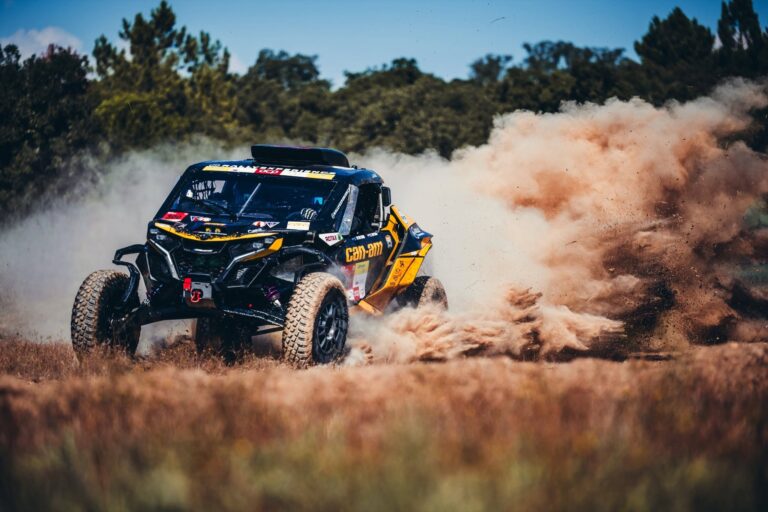
In the SSV class, the French duel from the prologue continued. Hugues Lacam and Delphine Delfino (MMP T3) were quickest at every waypoint up to kilometre 113 and held a 53-second lead over Lafay and Loïc Minaudier (Can-Am Maverick R) at that point. After the fuel neutralisation in Tataouine, that reversed completely. Lafay was almost eight minutes faster in the second part of the special and won the stage in 4:01:54. Lacam finished second at 6:49. Nicolas Martinez and Lili Delfino (Overdrive OT3) came third at 9:02, followed by Raoul Fenestraz and Lili-May Mansuy (Can-Am X3). Frédéric Henricy and Eric Bersey (Polaris Turbo R) were fifth.
For the German KTONE Motorsport, it was a black day. Stefan Kober and Martin Zeh rolled their car in the second part of the special and ended up with their Can-Am Maverick on its roof. Harry Thoma and Anja Schweyer, still fifth on the road at kilometre 45, also rolled. Both crews were unhurt but requested recovery and have retired. The Frenchmen Rinaldi René Jean and Tom Lepoureau (Polaris RZR Turbo R) also failed to reach the finish. Retired crews are classified with the maximum time of 8:40.
Britons Luke Wakelen and Jordan Dobson came 34th but were mainly satisfied afterwards. According to Wakelen, the car ran faultlessly and the navigation was “absolutely perfect”. For Dobson, it was his first event with a roadbook.
Cars: redemption for Thijs and Van Tiel
Because of their prologue penalty, Thijs and Van Tiel had to start 95th on Sunday morning. That meant driving in the dust of a large part of the field. “For us dust, lots of Sentinel and overtaking due to slow competitors”, Van Tiel summed up. He described the stage as a fast special with “sometimes tricky navigation”. Even so, they not only set the fastest car time but were also 1:52 faster than SSV winner Lafay. Magdalena Zajac and Blazej Czekan (Toyota Hilux) came second at 5:06.
Koen Wauters and Tom De Leeuw came third at 6:21. By his own account, Wauters deliberately did not drive an attacking run at the start: he let the car “do its thing” and tried to drive as consistently as possible. In the second part, a problem with the fuel pressure caused a brief scare. According to Wauters it cost about a minute, after which teammate Pascal Feryn and a fast SSV passed him. That was his cue to attack. Feryn and Keysers lost time near the end when their Hilux made an odd jump over a sand buildup. “Kurt and I did get out for a moment, but there was nothing to see on the car”, said Feryn. Wauters then passed again. Feryn finished fourth at 10:50, including a 3:20 penalty for speeding.
Wauters did add a caveat about the class. In his view, Thijs and Zajac are two cars “that we can’t match because they really belong in a different category”. Feryn Dakar Sport describes both Hiluxes as T1+ versions, while the Belgians drive an older Hilux. In the Fenix Rally’s Car Open class, however, they race against each other.
Belgians Vincent Vroninks and Dave Berghmans (Red-Lined VK56) came fifth at 19:50. Romanian Calin Camarasan, who did not finish the prologue, was sixth with his Ford Ranger. Italians Manuele Mengozzi and Elisa Tassile received a fifteen-minute penalty for a missed waypoint and dropped to ninth. Thomas Jolliffe and Mark Foster of JB Equipment Racing came tenth. Along the way, the cooling fan relay overheated. They spotted the rising temperature in time, bridged the relay on the spot, and have since replaced it with a heavier-duty variant. Steering on asphalt the team still calls “interesting”. Luxembourger Carlo Arendt retired.
In the Limited class, Tunisians Karim Benhassan Krayem and Nouichi Mohamed Elmecano (Toyota LC79), despite a two-minute penalty for a missed waypoint, built a lead of more than an hour over Austrians Ewald Holler and Markus Bodzenta. Abdennour Benabdennour and Abdelwaheb Dakhlaoui came third.
Trucks
Among the trucks, Paolo Calabria, Loris Calubini and Carlos Alberto Viña (MAN TGA) won the stage in 4:58:08. They held a 25:31 lead over the German crew of Stella Koerber. Michael Wolff and Roberto Briani (MAN KAT 1) lost more than two hours.
The Dutch SSVs
Among the SSVs, the Dutch contingent was closely bunched. Max and Sem van Empel (De Run Trading) came twelfth at 16:09, immediately followed by Rob van Horssen and Carlo Spreeuwenberg (Roca Racing Team) at 17:27. OryxRallySport’s two GPRs finished shortly after one another: Daniel Kersbergen and Michiel Goegebeur came seventeenth, Henri van Steenbergen and Daan van Ooijen nineteenth. In between, Arjan Donders and Edwin Vloemans (Polaris RZR Pro R) finished eighteenth. Harrie van Empel and Stefan van Ras came 25th, and “Captain Slow” and Jan-Willem van Mourik 31st, partly due to a two-minute penalty for a missed waypoint.
Dick van Culenborg and Marius Bos came 35th. Three kilometres before the finish, their Can-Am Maverick R stalled from fuel starvation, which cost about a quarter of an hour.
Coen Nooijen and Tijs Dijk dropped to 42nd through a seventeen-minute penalty for two missed waypoints. Thewessen and Spoor, still sixth on Saturday, came 43rd with a deficit of more than two hours. At kilometre 113 they were still 8:36 behind Lacam. After that the deficit grew sharply, and on top of that they received a fifteen-minute penalty for a missed waypoint. An explanation for the time loss is not yet known.
Loasis L’Original
In the Loasis L’Original, which runs alongside the Fenix Rally, classification positions were lost in almost every class due to penalties. In class 95, prologue winner Jules Maufret (Chevrolet) still led by more than five minutes at kilometre 92. In the end the stage win went to Serge Mogno and Jacques Perez (Toyota), with a 2:22 lead over Jean-Michel Villot; Maufret came fourth. In class 85, the win went after penalties to Eric and Christine Vallée (Toyota). Organiser Gilles Girousse came second, despite more than forty minutes of penalties. Julien Aurouze, still quickest at the first waypoint, retired. Alain Coquelle and Louis Boilly Coquelle (Bowler) remained the quickest in the 2005 class. In the Open class, Michel Salvatore won with Sabrina Gimenez, while prologue winner Jean-Jacques Ganteaume retired.
Stage 2: the first dune day
Today’s programme features a loop around Douz with 336.77 kilometres against the clock. It is the rally’s first major dune day. From kilometre 61, the navigation through dune fields, camel grass and faint tracks becomes noticeably harder. Around kilometre 117 comes the crossing of large dunes, a passage that applies only to the Fenix Rally; Loasis’s historic vehicles take a different route today. Halfway through, competitors use the same remote service twice. There is no commercial fuel there and the organisation provides no fuel stop, so the assistance teams must bring enough fuel and parts themselves. After the second restart at kilometre 202, the terrain becomes more varied, with tracks, oueds and several crossings of through roads. A mandatory two-second stop applies there.