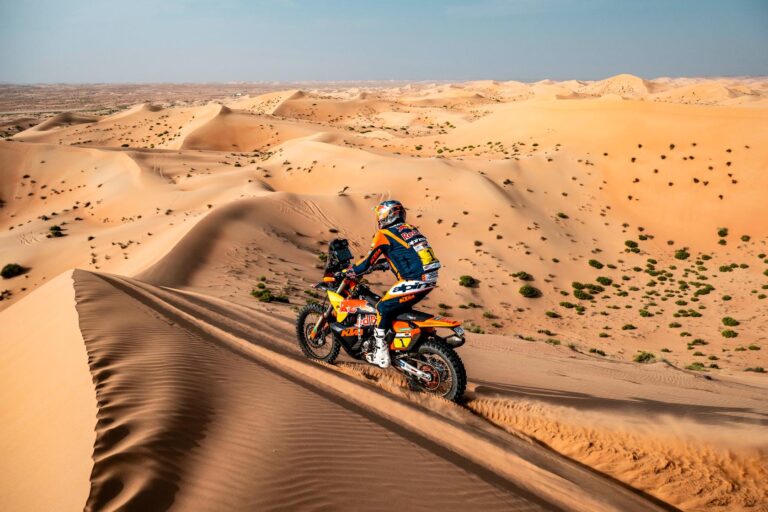

The Africa Eco Race organisation has announced the complete route for the 2027 edition. The 18th edition of the only cross-border rally raid linking North Africa with West Africa starts in Tangier on 24 January and finishes on 6 February on the shores of Lac Rose near Dakar. Along the way, the convoy crosses Morocco, Mauritania and Senegal over twelve stages, with a rest day in Dakhla.
The “Modern Race” for motorcycles, cars, SSVs and trucks covers 5,526 kilometres, of which 3,795 kilometres are against the clock. The “Historic Race” for cars and trucks built before 2007 follows its own route of 5,304 kilometres, with 2,544 kilometres of selective sections spread over eleven stages. For the second year in a row, Tangier is the starting point. In 2026, the rally started on the African continent for the first time instead of in Europe.
Two days of scrutineering in Tangier
The vast majority of participants make the crossing together, after which all competitors and the organisation gather in Tangier. The port city hosts two days of technical and administrative checks, followed by a start ceremony. On 24 January the official grand start takes place, with a first transfer day to Meknès. The competition itself begins a day later.
Morocco: five stages through the deep south
Stage 1 on Monday 25 January, from Meknès to Erfoud, has 91 kilometres against the clock (in two sectors of 33 and 58 kilometres) and is intended as a Moroccan warm-up, with stony tracks across the high plateaus and the first sandy wadis near the palm grove of the Tafilalet. From stage 2 to Mhamid, things get serious. The first big dune belts, the desert plains and the sand tracks of the Drâa Valley lead to the oasis over 374 kilometres against the clock.
Three stages follow, all of them well over four hundred kilometres. Stage 3 from Mhamid to Assa (460 kilometres) crosses vast dry lakebeds, fast tracks over rocky plains and rugged terrain. Stage 4 to Laâyoune (452 kilometres) heads towards the Atlantic Ocean through a mineral landscape of canyons and sandy wadis. Stage 5 to Dakhla (428 kilometres) combines a sea of white sand without landmarks with coastal cliffs above the Atlantic Ocean. On Saturday 30 January there is a rest day in Dakhla, where mechanics can check the vehicles before the Mauritanian expanse awaits.
Mauritania: the heart of the rally
Stage 6 on Sunday 31 January, from Dakhla to Bénichab, begins with the traditional link section to the Mauritanian border: 525 kilometres of liaison for the Modern Race (603 kilometres for the Historic Race) against 175 kilometres against the clock. After that comes the plunge into the Sahara with the first big Mauritanian dune belts.
Stage 7 is a 373-kilometre loop around Bénichab, entirely through sand: cathedral dunes, sandy valleys and demanding navigation without a track. Stage 8 to Tabenkroute is the longest timed stage of the 2027 Modern Race at 480 kilometres, combining technical dunes, mountain passes and isolated desert plateaus in the Adrar. Stage 9 (433 kilometres) starts and finishes directly at the bivouac in Tabenkroute, a symbolic place: the area was the favourite location of the late René Metge, former sporting director of the Africa Eco Race. Stage 10 (420 kilometres) leads to Toujounine near the capital Nouakchott, across dune belts with camel grass and fast sand tracks on the edge of the Sahel.
Senegal: the final kilometres to Lac Rose
On Friday 5 February, competitors cross the Senegalese border in stage 11 via Diawling National Park. The landscape changes radically: the mineral-rich desert gives way to Sahel savannah, red laterite tracks with baobabs and lively villages on the way to Mpal. With 87 kilometres against the clock for the Modern Race (an 85-kilometre selective section for the Historic Race), this marks the end of the sporting battle. The standings are frozen and the winners in all categories are known.
The final stage on Saturday 6 February, from Mpal to Dakar, includes one last timed stage of 22 kilometres over the beach and around Lac Rose, after a 247-kilometre link section along the Senegalese coast. This stage is for honour and has no influence on the standings. The public welcomes the competitors at the closing ceremony and prize-giving. For the Historic Race, the last day is a link stage to Dakar.
Three categories, two routes
The Modern Race and the Historic Race each follow their own route. In addition, there is the Raid, for motorcycles and cars. This category is intended as an introduction to the rally: participants experience the atmosphere of the shared bivouacs without rankings and without time pressure. In 2027 the Raid is available in two variants. Raid Évolution follows the race route exactly, with the same demanding driving style and roadbook navigation, but with slightly adjusted stage distances. Raid Travel alternates accessible off-road sections with link routes through impressive landscapes. According to the organisation’s offer, the number of Raid participants is limited to a maximum of twenty cars and twenty motorcycles, for Travel and Évolution combined.
Historic Race: navigation, regularity and time gates
The Historic Race has no pure speed tests. The 2,544 kilometres of selective sections (ZS) consist of three types of assignments:
- ZNV (navigation zones): using a map, ruler and protractor, crews must find a series of waypoints in a fixed order by determining direction and distance themselves. Between the points, the choice of route is free.
- ZTG (time gate zones): the zone is divided into consecutive sections in which each time gate must be reached within an allowed time. Driving fast is allowed, only arriving late is penalised. The clock restarts at every gate, with no cumulative effect.
- ZRS (sporting pace zones): crews follow the prescribed route and strictly adhere to the ideal passing times from the roadbook. Secret checkpoints monitor the pace, and every deviation outside the tolerance, too early or too late, costs one point per second.