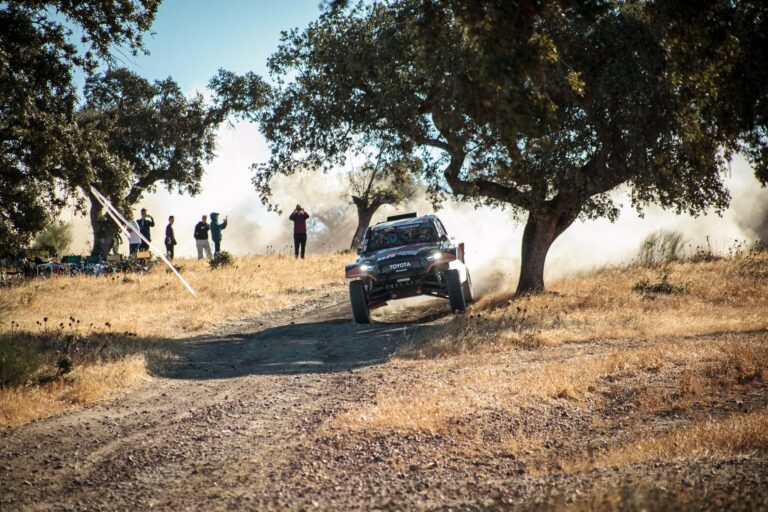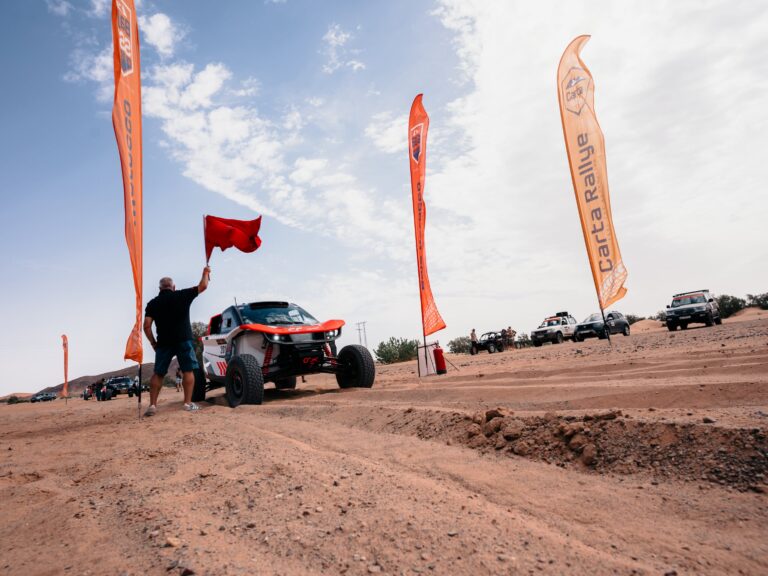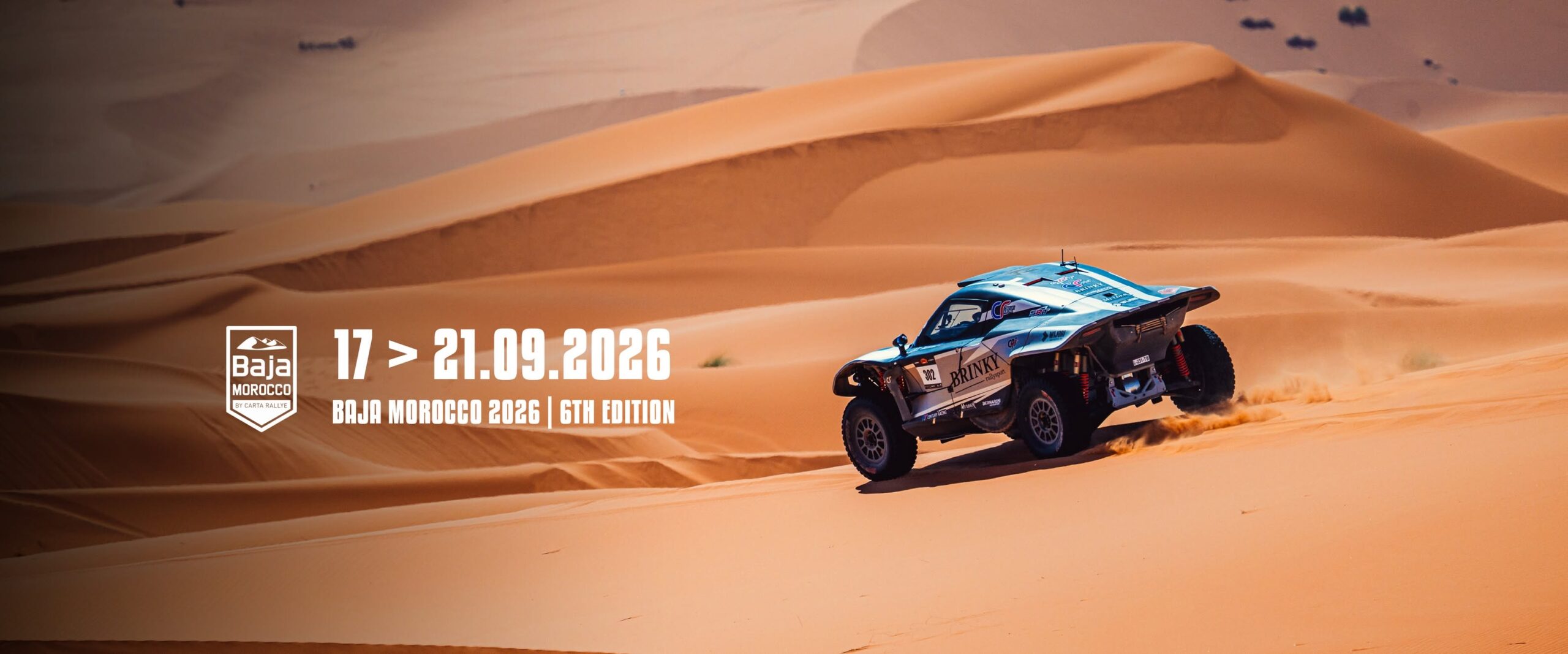

On Thursday 17 September, the sixth edition of the Baja Morocco gets under way in Merzouga. This edition of the rally-raid run by the organisation behind the Carta Rallye counts 68 vehicles: 17 bikes, 11 cars and 40 SSVs. Five stages are on the programme around the bivouac at Hotel Nomad Palace, on the edge of the dunes of the Erg Chebbi.
The entry list is a mix of enthusiasts and experienced crews using the event as preparation for the autumn and the Dakar Rally. Defending champions Mathieu Serradori and Loïc Minaudier return, as do Simon Vitse and the Japanese Toyota Auto Body. The Netherlands is represented by Kees Koolen with Wouter Rosegaar in a Ford Raptor and Rik van den Brink in a Century CR7. Puck Klaassen, who finished second among the SSVs last year, is also on the start line, with her partly Dutch roots.
From SSV event to full-fledged rally-raid
The Baja Morocco began in 2021 as the Baja SSV Morocco, a competition exclusively for SSVs. In 2023 bikes were admitted, and at the fourth edition in 2024 the cars followed, at the request of Carta Rallye participants. Last year, when the rally was held in early October, 66 vehicles started, a record at the time. With 68 entries the event is growing, though the make-up has changed. The number of bikes has almost doubled, from nine to seventeen, and the number of cars went from ten to eleven, while the SSV field decreased slightly.
The concept has remained the same since the start: five days of racing from a single fixed base, where participants return to the same hotel after every stage. The administrative and technical scrutineering have meanwhile begun and the first shakedowns have already taken place.
The stages
The route runs through the area around Merzouga, where the sand dunes of the Erg Chebbi alternate with fast technical tracks and dry riverbeds. Every stage starts and finishes in the immediate vicinity of the bivouac. In total the participants cover 1,389 kilometres of special stages, supplemented by 77 kilometres of liaison.
The rally opens on Thursday with a 277-kilometre special stage west of Merzouga. The start and finish are right by the bivouac, so there are no liaison sections. On Friday too the focus lies in the west. After a short 7-kilometre liaison comes a 302-kilometre stage that finishes north of Merzouga, 12 kilometres from the bivouac.
Saturday brings the longest day of the week at 428 kilometres. The 380-kilometre special stage again heads west and south-west. The participants first drive 10 kilometres to the start and, after the finish south of Merzouga, another 38 kilometres back to the bivouac.
On Sunday the scenery shifts to the area north of Merzouga. The 300-kilometre stage starts at the bivouac and finishes 10 kilometres away. The rally concludes on Monday with a compact 130-kilometre stage east of Merzouga, with the start and finish at the bivouac. That same evening the prize-giving takes place at the hotel.
Serradori defends his title
Among the cars, the role of favourite falls to Mathieu Serradori and Loïc Minaudier. The French duo won the car classification last year with SRT’s Century CR7 and return with the same combination in the Ultimate 4WD class. Their main challenger back then was Simon Vitse, winner of the Carta Rallye 2025, who starts with the MD Optimus Evo 5 in the Ultimate 2WD class. Whereas Vitse had Max Delfino alongside him last year, the provisional list shows Delphine Delfino as navigator.
Jérôme Cambier, winner of the 2024 edition, drives an MD Optimus Evo 5 this year with Antoine Lecourbe under the Securelec Socem banner in the Auto 2WD class. In the same class, David Gerard and Pascal Delacour start with an MD Optimus. Toyota Auto Body, which came to test a Land Cruiser 300 GR last year with Akira Miura and Jean-Michel Polato, now brings two cars in the Auto 4WD class. Former SSV world champion Yasir Seaidan shares the cockpit with Polato, while Christian Lavieille drives with Valentin Sarreaud.
Century Racing is present with a works CR7 for Jayden Els and Johannes Swemmer. Red-Lined Europe enters two Revo T1+, for Dave Beecroft with Fraser Parish and Daniel Beecroft with Philipp Gillespie.
Largest class without a defending champion among the SSVs
With forty crews, the SSVs remain the backbone of the event. Mickaël Metge, who finished ahead of Klaassen in the SSV classification last year, is not on the provisional list. That makes Puck Klaassen the highest-placed returner from 2025.
A number of teams are strongly represented. BTR brings seven Can-Am crews to the start and BBR four, with two Taurus cars and two Odysée CRX entered together with Century Racing. One of those Odysées is driven by Brian Baragwanath, with Jayden Els as navigator.
MMP vehicles are entered six times, including for the experienced Hugues Lacam with Diego Lormand (Speed Up) and for two Ultimate Dakar crews with Matěj and Tomáš Ouředníček and Martin and Filip Vondrášek. Also on the list are Grzegorz Brochocki and Grzegorz Komar (Overlimit, Taurus) and Adam Kus and Maciej Giemza (AKPOL Recykling Rally, Taurus Evo Max), among others.
A new winner on two wheels
Among the bikes, a new winner is certain, because last year’s top two, Benjamin Melot and Charlie Herbst, are absent. Noa Sainct, son of the late three-time Dakar winner Richard Sainct and third last year, is the only podium rider from 2025 to return. He rides again for Nomade Racing, together with Franck Verhoestraete and Christopher Jautard.
Casteu Trophy enters three KTMs for Louis Trelluyer, Gabriel Ernst and Boris Bretez. Konrad Dąbrowski, who competed last season for Duust Rally Team in the junior class of the FIM Bajas World Cup, starts again for that team. Sara Jugla, on a Kove, is the only woman in the bike field. With twelve of the seventeen bikes, KTM is the best-represented make.
Dutch involvement
Rik van den Brink lines up in the Ultimate 4WD class with an SRT Century CR7, making him a teammate of defending champion Serradori. Van den Brink discovered rallying in 2018 on a quad in the Breslau and made his debut in 2025 with navigator Gydo Heimans in the Dakar Rally, where the pair finished 33rd. Last year Van den Brink was active in Merzouga as well, setting the third-fastest time among the cars on the fourth stage.
Puck Klaassen starts alongside Argentine navigator Augusto Sanz in G Rally Team’s G-Ecko, entered as the KTM X-Bow Lab Team, in the Open Plus class. The Dutchwoman, who grew up in South Africa, won the first stage of the Baja Morocco last year by around four minutes over Metge and finished second in the SSV classification. She has taken a big step since then. In the 2026 Dakar Rally she finished fifth in the Challenger class and won two stages, becoming the fifth woman ever to win a Dakar stage. In the W2RC season she finished seventh among the Challengers in Portugal and third in the Desafío Ruta 40 in Argentina. In Merzouga she is regarded as one of the contenders for the SSV win.
Kees Koolen and Wouter Rosegaar drive a Ford Raptor for RD Limited in the Ultimate 4WD class. Koolen, former head of Booking.com, has raced the Dakar Rally over the years on a bike, in a quad, in a truck and in a car, and won the first W2RC season in the truck category in 2022. In this year’s Dakar he was still racing in the Challenger class with Jurgen van den Goorbergh. This season he switched to a Raptor T1+ with Rosegaar, with which the pair took part in the W2RC rounds in Portugal and Argentina.