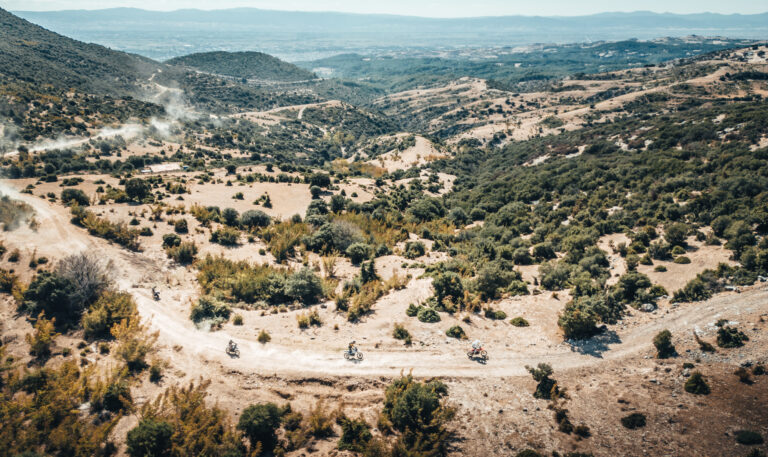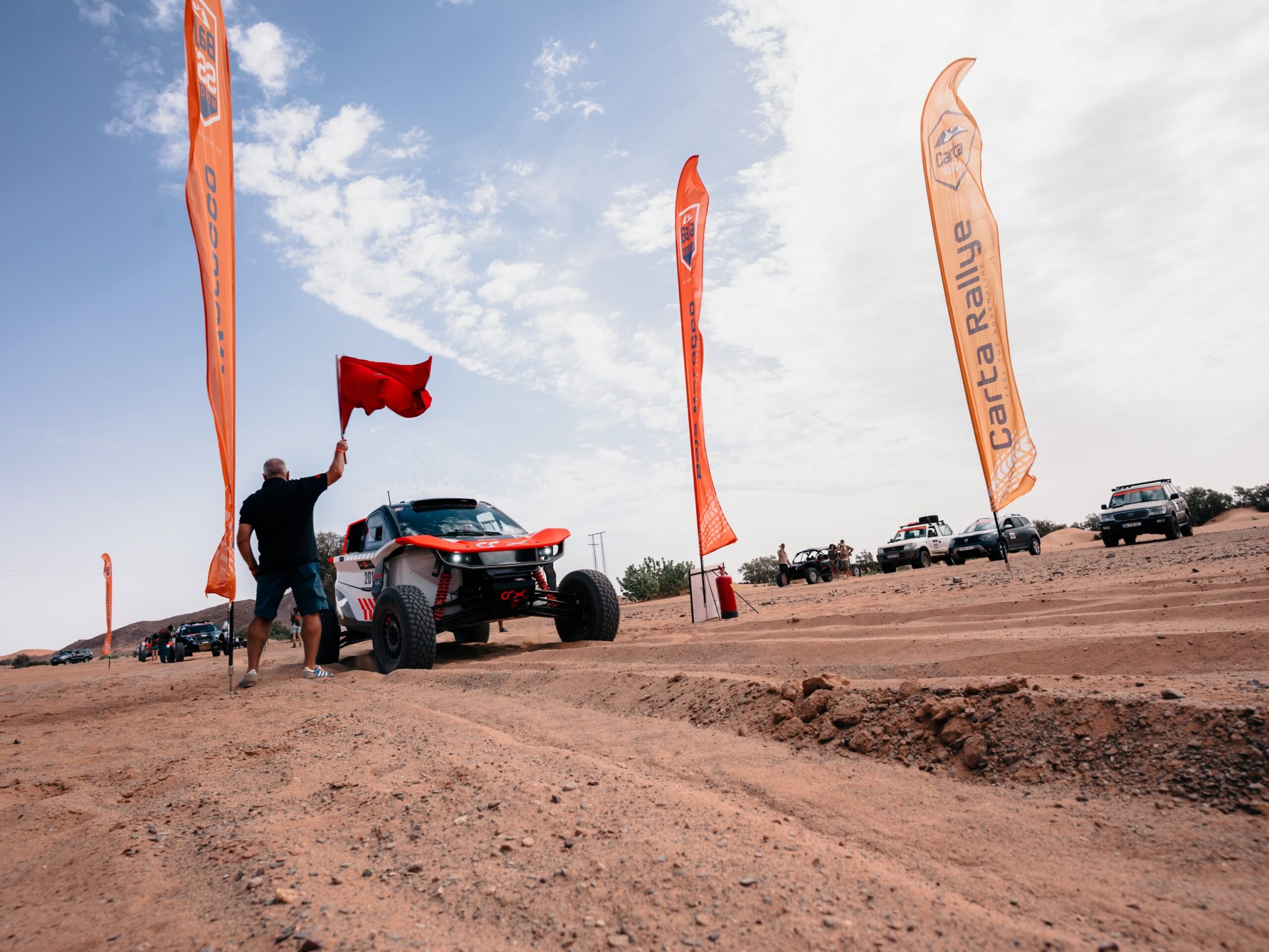

The sixth Baja Morocco got under way on Thursday in Merzouga with a demanding opening stage. Competitors faced 270 timed kilometres, including 35 kilometres of dunes and a route that ran through both the dunes of Ouzina and the Erg Chebbi. The start was located directly behind the hotel, which made navigation essential from the very first kilometres. The rain of recent days played a part: tracks had been erased, wadis could be full of water, and in the briefing the organisation gave an explicit warning about the changed terrain.
In the end, 65 vehicles lined up at the start: seventeen bikes, ten cars and 38 SSVs. That is three fewer than the provisional entry list showed. Among the bikes, Dane Thomas Kongshoj (Challenger Racing Team) was a late addition. Among the cars, the works team’s Century CR7 was missing, with Jayden Els switching from the cars to the SSVs to join Brian Baragwanath in the Odysée CR-X of BBR and Century Racing. In the SSV class, the absentees included Léonardo Ribeiro’s Taurus and the AKPOL Recykling Rally crew.
Sainct on the attack straight away
Noa Sainct made it immediately clear that he is not here for third place this year. The Frenchman from Nomade Racing set a time of 5:32.02 on his KTM and, as the only rider without a bonus or penalty, was almost nineteen minutes faster than teammate Franck Verhoestraete. The Belgian kept the damage limited but already saw the gap grow on the opening day.
Behind them the differences were large. Louis Trelluyer of Casteu Trophy finished third at 1:12.58, with a fifteen-minute penalty applied to him and to a large part of the field. Kongshoj followed just under a minute behind Trelluyer, ahead of Christopher Jautard, Boris Bretez and Richard Hodola. Sara Jugla, the only woman in the bike field, moved up to eighth thanks to a bonus of just over half an hour. Belgians Benjamin Defrère and Eric Penners finished eleventh and twelfth.
Of the seventeen bike riders who started, fourteen appear in the provisional results. Olivier Balloy, Stéphane Legrenzi and Simon Kervarrec were not awarded a time.
Andújar wins, Baragwanath sets the fastest time
For the cars and SSVs the organisation draws up a single combined classification in which bonuses and penalties are incorporated. Those corrections turn the order of the finishing times firmly upside down and are therefore decisive for the final result of the day.
Baragwanath and navigator Els were the fastest of the entire field with 5:14.37 on the clock, quicker than all the cars. After a penalty of 16.24, the South African crew came out at 5:31.01 in the provisional results, placing them third. The stage win went to Manuel Andújar and Cesar Andres Frini, a Dakar winner in the quads and now competing in a Taurus Evo Max of 7240 Rally Team. They received just over 35 minutes of bonus and fifteen minutes of penalty, good for a final time of 5:16.57. Portuguese pair Alexandre Pinto and Bernardo Oliveira were second in the other Odysée CR-X at 7.33, ahead of Baragwanath and Adrien Choblet with Paul Durame of Casteu Trophy.
That these are substantial corrections is clear in the case of Axel Knauf and Jonathan Lurquin. The Belgians posted the second-fastest time of the day on the clock with 5:29.20, but a penalty of almost seven hours left them at 12:16.00 and in 21st place. The results give no explanation of the bonuses and penalties awarded.
Baragwanath also used the day to test the new Odysée CR-X. He described the car as “a mini T1+”, just as fast in the rough terrain as in the dunes, and praised BBR and Century Racing for the new model.
For Harite Gabari the day ended prematurely. The Moroccan and his French navigator Vincent Ferri had worked their way forward during the stage, but around forty kilometres from the finish both upper control arms of his Can-Am broke. Gabari simply called it “la dure loi du rallye-raid”, the harsh law of rally-raid.
Serradori the best car after corrections
Among the cars, Simon Vitse initially looked to be taking revenge on Mathieu Serradori. With Delphine Delfino alongside him in the MD Optimus Evo5, he finished in 6:13.34, 33 seconds faster than Serradori and Loïc Minaudier in the Century CR7. In the provisional results that picture was reversed: Serradori received just over half an hour of bonus and came out at 5:43.10, while Vitse, on top of his bonus, also had thirty minutes of penalty added, good for 6:04.41. That puts Serradori fifth in the combined classification and Vitse eighth.
Daniel Beecroft and Phillip Gillespie follow in the Redlined Revo T1+ in eleventh place with 6:08.16. Jérôme Cambier and Antoine Lecourbe are sixteenth with 6:30.26, and David Gerard and Pascal Delacour close out the results with 13:37.02. In total, 22 of the 48 cars and SSVs that started were awarded a time. Among the cars, both Land Cruisers of Team Land Cruiser Toyota Auto Body are missing, along with the second Redlined of Dave Beecroft and Fraser Parish, which leaves only five of the ten cars in the results.
Bad luck for Van den Brink
For Rik van den Brink and Gydo Heimans the opening day went wrong before the stage had really begun. The pair were already struggling with a power problem in the SRT Century CR7. “Yesterday and this morning we had problems with the engine power”, Heimans reports. The fault appeared to have been solved, but after a few kilometres into the stage it turned out that it had not, and the Dutchmen returned to the bivouac. According to Heimans the problem has since been fixed and tested, and the pair will be back at the start on Friday.
The two other Dutch crews did not get to race either. Kees Koolen and Wouter Rosegaar stood last on the start list with their RD Limited Ford Raptor, but did not run the special stage. The same goes for Puck Klaassen and her Argentine navigator Augusto Sanz, who were listed second to last among the SSVs with the G-Ecko of G Rally Team. Both vehicles simply remained in the bivouac in Merzouga at the end of the day. Klaassen won the opening stage of the Baja Morocco last year and finished second in the SSV classification.
Friday: La Momie
The second stage is named La Momie and consists of 298 kilometres of special stage, with a 6.5-kilometre link to the start and 12.5 kilometres back to the bivouac. The organisation describes the day as difficult across the board, with a poor and poorly visible piste from the start and, towards the end of the stage, several crossings with the crew’s own tracks from that morning.
Various sections have been neutralised, partly over asphalt and partly over rough terrain, and on a number of pistes crews must allow for traffic. As on Thursday, the organisation warns of water and mud following the recent rainfall. At kilometre 95 and kilometre 200, at the same point, there are fuel stops with neutralisations of twenty and 45 minutes respectively, during which assistance is permitted within a marked-off zone.
(All times and results mentioned have been adjusted on the basis of the definitive stage results, including time penalties.)