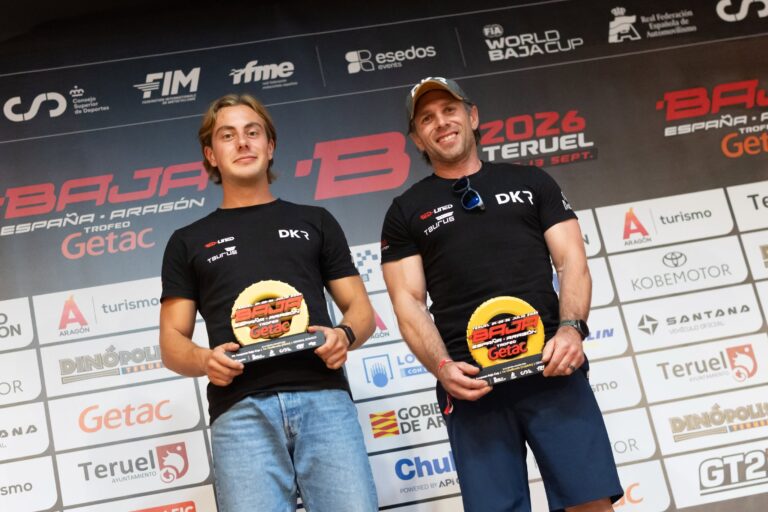

From 17 to 20 September, the Portuguese Alentejo will be the setting for the 38th Baja TT Sharish Gin. This baja counts for the cars toward the FIA European Baja Cup and the Portuguese baja championship. Motorcycles, quads and SSVs compete in a separate event for FIM Europe’s Bajas European Championship. The big favourite is João Ferreira, who won the last four editions with navigator Filipe Palmeiro and last weekend also claimed the Baja España Aragón in Teruel.
The field is large. The FIA entry list counts 44 cars, 41 motorcycles, 10 quads and 72 SSVs. The Netherlands is represented in the car field, with four crews in the Ultimate and Challenger categories. The schedule is tight. After Baja Aragón the teams had only a few days to get everything ready, and immediately afterwards it all moves on to the Rallye du Maroc and the Baja Portalegre.
Ferreira favourite, but no Aragón competition
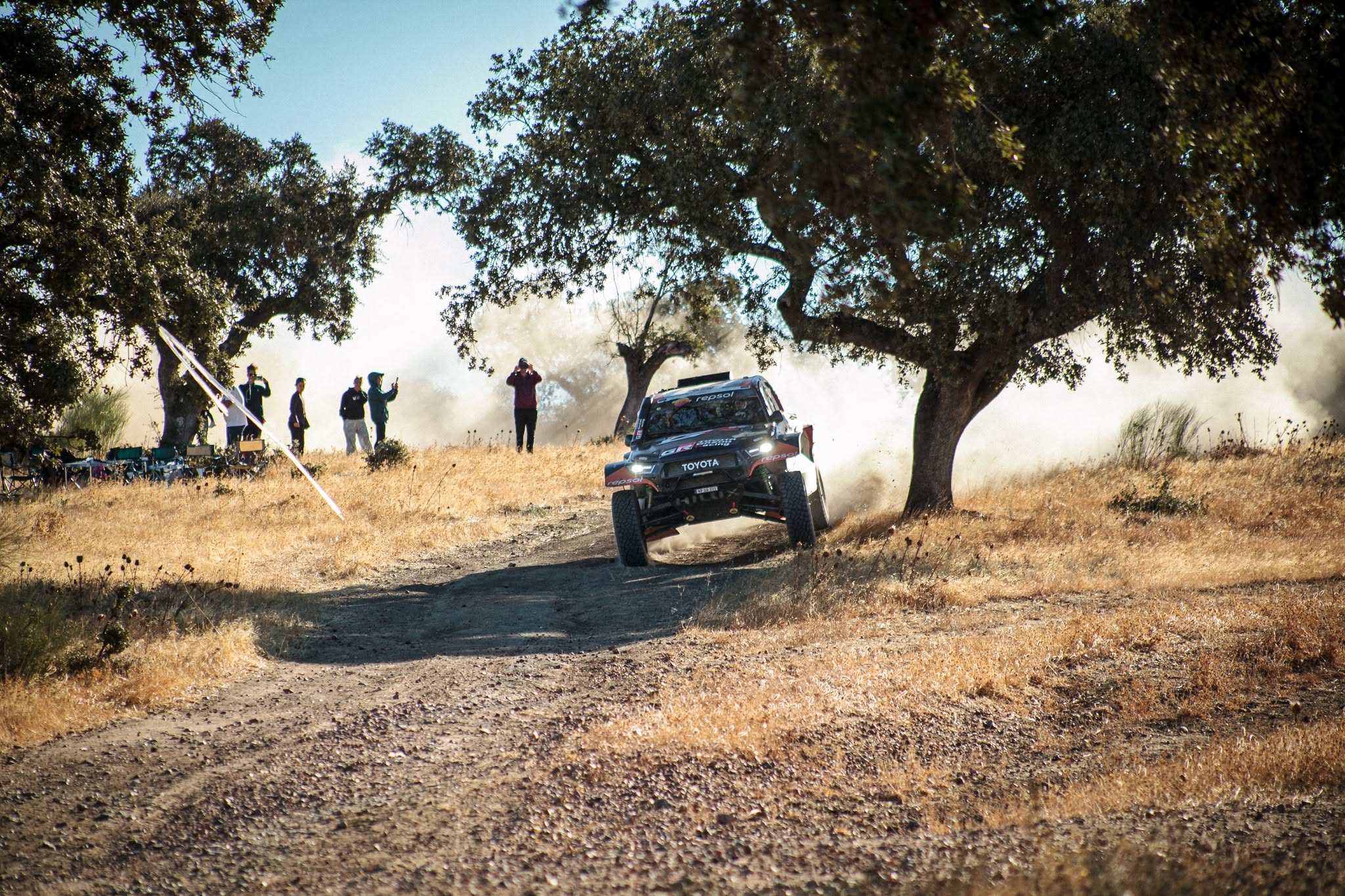
Ferreira and Palmeiro start with number 207 in a Toyota Hilux EVO, entered by Toyota Gazoo Racing South Africa. Ferreira calls the baja one of his favourite races: fast, with highly technical passages, while heat and rocky terrain make it hard on car and crew in his view. With four consecutive wins, a fifth is “naturally” the goal, according to the Portuguese driver. A new victory would place him second on the roll of honour on his own, behind Miguel Barbosa, who won the race nine times between 2002 and 2015.
The main challenger appears to be Guillaume de Mévius. Last year the Belgian finished second behind Ferreira with Mathieu Baumel, and he starts again in an X-raid Mini JCW Rally 3.0i. The German team also fields Maria Gameiro and Rosa Romero in the diesel version of the Mini. The Czech Karel Trněný (Ford F150 Evo+), the Pole Mariusz Wiatr (Ford F150 Evo) and Magdalena Zając (Toyota Hilux) complete the international lead group in the Ultimate class.
On home soil, Ferreira is joined by João Ramos and Jorge Carvalho in the Toyota Hilux EVO of Toyota Gazoo Racing Caetano Portugal. Ramos won the baja in 2006 and finished third with Carvalho in 2023. Alejandro Martins, who stood on the podium four times between 2016 and 2021, drives an X-raid Mini with João Rato, while José Rogeira starts in a Ford Ranger. In the T1.1 class, César Sequeira’s Mercedes-Benz 350 SLC Coupé stands out.
Familiar names in Challenger and SSV
The Challenger class counts sixteen entries. Dinis Rogeira, earlier this season the only points scorer in this category of the European Baja Cup, starts in a Can-Am Maverick X3. The German Paul Schmidt drives the X-raid Fenic with the Dane Jeannette Kvick, and the Pole Marek Kubiczek a Taurus Evo Max. Well-known Portuguese names are Tiago Reis, winner in 2018 and 2021 and now in an MMP T3 Rally Raid, Nuno Matos, winner in 2016, in a Volkswagen Amarok, and Edgar Condenso with Nuno Silva in a Kaizen S1. The same pairing already finished second back in 2006.
Among the SSVs, Paulo Rodrigues and Fausto Mota catch the eye, having taken the class win in the European Baja Cup in Poland at the end of August. Record winner Miguel Barbosa now drives a Polaris RZR Pro R, as does Gonçalo Guerreiro, who won the Challenger class in a Taurus in Aragón last weekend. Luís Cidade, SSV winner in 2020, starts in a Can-Am Maverick R. In the Stock class, the Belarusian Andrei Halabarodzka (Toyota Land Cruiser) and Fernando Barreiros (Isuzu D-Max) are entered. Barreiros finished second in the overall standings of the European Baja Cup in 2024.
Four Dutch crews
For some of the Dutch competitors, Baja Sharish is the second baja weekend in a row. Several were still racing in the Baja Aragón last weekend and travelled straight from Teruel to the Alentejo. Between the finish in Teruel on Sunday and scrutineering in Reguengos on Thursday, only a few days remained to go over the cars, repair them and move them to Portugal.
Pim Klaassen is the only Dutchman entered for the European Baja Cup. He drives number 209, the DKR Evo GTR from the DaklaPack Rallysport stable, in the Ultimate class. Where he had the South African Leander Pienaar alongside him in Aragón, in Portugal the Portuguese Joel Lutas navigates. After the Spanish stages, the new combination therefore has to gel immediately.
Henk Klaassen mainly brings confidence with him from Spain. With Thai navigator Sasha Siripanyavuthi he finished third in the Challenger class in Aragón. Without a rest weekend in between, the pair start in Portugal with number 306, again in the same Taurus T3 Max.
Paul Spierings also races in the Challenger class. He starts with number 304 in a Taurus Evo Max, with Kala Senders as navigator.
Johannes Senders and Yvet Senders complete the Dutch contingent. They drive number 211, a Toyota Hilux in the T1.1 class, where they take on Sequeira and Hugo Raposo (Nissan Proto).
Motorcycles, quads and SSVs
Among the motorcycles, Micael Simão defends his win from last year, now on a KTM EXC F from Santag Racing instead of a GasGas. Tomás Dias (Honda CRF 450RX) finished second in each of the last three editions and is chasing his first victory. José Rijo, third in 2025, and Gustavo Gaudêncio, winner in 2021, are also on the start line. From abroad come, among others, the Pole Joanna Modrzewska (Triumph TF450E) and the Spaniard Víctor Moya (KTM). Pedro Bianchi Prata rides the electric Strix in a separate ELE class.
A striking name is that of António Maio, who won the baja in 2016, 2018, 2020 and 2023. After the summer break he takes to a Yamaha Ténéré and wants to show what the bike can do. He expects strong opposition and intends to ride every kilometre “with maximum concentration and determination”.
Among the quads, Tomás Paulo (Yamaha YFZ450R) is the defending champion in a field of ten competitors, including the Pole Marcin Wiłkołek. With 72 entries, the SSV field is the largest of the weekend. Nelson Caxias, winner last year and third in 2023 and 2024, starts with number 801. Roberto Borrego (winner 2024), Pedro Santinho Mendes (winner 2023), Pedro Antunes and Miguel Cunha are also among the contenders, as are Afonso Oliveira and Daniel Jordão, who won the SSV class in Aragón last weekend.
Programme and route
Thursday features the administrative and technical checks, followed for the cars by a shakedown. On Friday the race begins with a 6.2-kilometre prologue for the cars in the morning and for motorcycles, quads and SSVs in the afternoon. The cars then immediately tackle a first selective section of 60 kilometres. Saturday is the longest day for the cars with 300 kilometres against the clock, while the motorcycle riders cover 144 kilometres. Sunday brings another 60 kilometres for the cars and 150 kilometres for motorcycles, quads and SSVs. Added up, the cars thus reach over 420 and the two-wheelers 300 kilometres at speed.
The route runs through the municipalities of Reguengos de Monsaraz and Mourão, along the Alqueva reservoir. According to the municipality, the route passes Carrapatelo, Motrinos, Telheiro, the medieval Monsaraz and the pottery village of São Pedro do Corval, among others, with start and finish on the Praça da Liberdade in Reguengos.