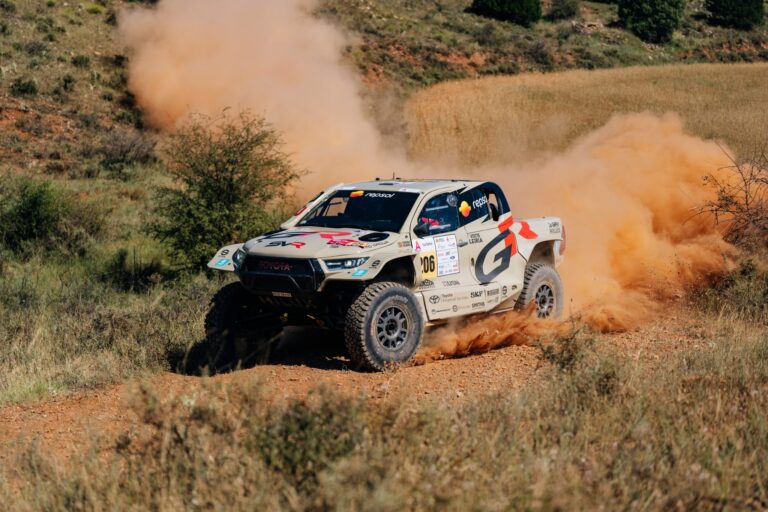
The 41st edition of the Baja España Aragón kicked off under ideal conditions in Spain’s Teruel region. What began with an early start for the motorcycles evolved into a fast-paced opening day of rallying, full of dust, speed, and strategy. Competitors faced two special stages: the longer and rougher Torrijo del Campo – Gea de Albarracín stage, and the more classic Argente – Cella route.
With top contenders like Nasser Al-Attiyah, Lorenzo Santolino, Martin Macík, and João Ferreira in the mix, the pace was fierce from the very first kilometer. Dutch teams also made their mark, including Richard de Groot in the truck category and Mitchel van den Brink in the SSVs. As Sherco dominated the motorcycle division and Dacia positioned itself at the front among the cars, it became clear that this edition would once again be a true test of skill and endurance.
Santolino in the lead, Trigo and Cox Impress
The opening day of the 2025 Baja España Aragón began before sunrise, with the motorcyclists setting off at 6:00 AM for two demanding stages: the longer SS2 from Torrijo del Campo to Gea de Albarracín (199 km), followed by the shorter but intense SS1 from Argente to Cella (132 km).
Spaniard Lorenzo Santolino (Sherco) wasted no time asserting dominance, convincingly winning both specials. He clocked an impressive 2:53:11 in SS2 and followed it with 1:53:18 in SS1. With a combined time of 4:50:59.0, he leads the overall classification.
South African Bradley Cox, also riding for Sherco, struggled to find rhythm on his new bike but still managed top-five finishes.
A standout performance came from young Spaniard Alonso Trigo, who overcame suspension issues in the morning to finish second in SS1. He now sits third overall, just behind Frenchman Neels Theric (Kove), who excelled through consistency.
In the quads, Jérôme Connart (Yamaha) once again set the benchmark, finishing with a combined time of 5:08:42.0—good enough for eighth overall. Among the women, Sara García (Yamaha) was the fastest, reaffirming her status as the favorite.


Millimeters between Al-Attiyah and Ferreira
The car category saw a thrillingly close battle. In the morning SS1, Spanish veteran Nani Roma posted the fastest time in his Ford Raptor (1:39:34.9), closely followed by Nasser Al-Attiyah in the Dacia Sandrider and Portugal’s João Ferreira (Toyota), who lost just seconds despite suffering a puncture.
The tables turned in SS2 as Ferreira set the fastest time (2:35:58.1), with Al-Attiyah trailing by just half a second (2:35:58.6). Roma lost time here but stayed in contention. After day one, Al-Attiyah leads the overall standings with a total time of 4:15:42.3, just 13 seconds ahead of Ferreira. Roma sits third, 1 minute and 51 seconds adrift.
The only Dutch crew entered in the FIA class, Ronald Schoolderman and co-driver Mark Salomons in a Mitsubishi, drove a consistent race but remained outside the top 30.
In the Challenger and SSV categories, four Dutch crews took to the stage, each with their own ambitions and challenges. Pim Klaassen, driving alongside navigator Wade Harris for the Daklapack Rallysport Team, completed a solid first day in their Taurus T3. While not yet among the frontrunners in the standings, the pair drove consistently and avoided major mistakes—crucial in a rally where endurance is just as important as outright speed.
In the SSV class, Mitchel van den Brink and Bart van Heun delivered an impressive performance. Paul Spierings and Dick van Culenborg, as well as Henk Klaassen with co-driver Mark Lann, also competed in Tauruses and completed the first day without significant technical issues.
“We took a cautious approach. There were many drivers with punctures, and we wanted to avoid that, so we backed off the pace slightly. Still, we made good progress in the overall classification by winning both stages. The crews ahead of us aren’t registered for the World Cup. So far, we’re very satisfied and hope to secure a podium position in the third stage tomorrow,” said Mitchel van den Brink.
Macík dominates, Dutch trucks in the top three
In the truck category, Czech driver Martin Macík was untouchable, winning both specials decisively (SS1: 1:54:18.3, SS2: 1:42:51.6) for a combined time of 3:37:09.9. A strong showing from the Belgian team Rotsaert/Lapere/Dewitte put them just 15 seconds behind in second place.
On the Dutch side, Richard de Groot, Jan Hulsebosch, and Martijn van Rooij impressed with their Iveco Powerstar, claiming third overall and staying within 20 seconds of the leaders.
Other Dutch teams flying the Rainbow colors—Tjeerd van Ballegooij and Gerrit Zuurmond—had a solid but slightly less speedy day, ranking fifth and sixth in the current standings. Meanwhile, the all-female team of María Helena Tarruell persevered through technical issues to successfully complete their first Baja stage.
Looking ahead to day 2
Sunday, the final day, brings no new terrain but instead a repeat of the 132-kilometer Argente to Cella stage. While now familiar, the route remains treacherous. In nearly every category, gaps are tight, and even the smallest mistake could prove decisive. With mild weather expected—around 30°C and little wind—day two promises a tense and thrilling finale to what is already a memorable edition of the Baja España Aragón.