


Long before the first motorbike, car, or truck roars to life on African soil, the backbone of the Africa Eco Race is already in place: the roadbook. This so-called “desert bible” is the guiding compass for every competitor throughout the stages of dunes, rock fields, and endless pistes across Northwest Africa.
But how is such a roadbook actually created? RallyTracks took a look behind the scenes with the organization of the Africa Eco Race, diving into the work of Sports Director Manfred Kroiss and his team.
From drawing board to desert plains
Preparation for the rally adventure begins six months before any tires touch the sand. During this period, the team assesses the feasibility of each stage: distances, terrain variety, safety, logistics, and access for two-wheel drive vehicles. Fuel stops must be placed every 250 kilometers for motorbikes, helicopters need safe landing zones, and each bivouac must be reachable within GSM coverage. The challenge is to balance excitement with safety, not only for the competitors but for the entire traveling caravan that moves with them day by day.
Four people, two vehicles, one mission
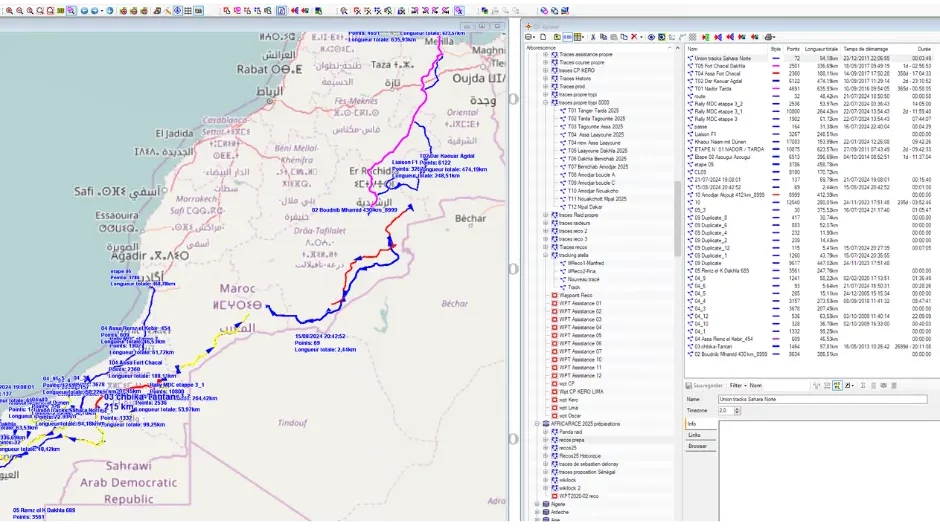
After months of planning with maps and satellite data, it’s time to take to the field. Over three to four weeks, a small crew, usually two to three vehicles, explores the route across the desert in full autonomy. The lead car opens the path, while in the second vehicle, Manfred Kroiss himself sits armed with a GPS, notebook, and camera.
Every waypoint is documented, and each direction logged. Roadbook notes are hand-drawn on the spot, complete with symbols, distances, and crucial guidance. Everything a competitor needs to know is captured right then and there.
Precision down to the meter
A long stage can easily contain 300 individual notes. Across the whole rally, that adds up to around 2,500 unique instructions. To minimize error, the entire reconnaissance is recorded using dashcams. This allows every meter to be reviewed and double-checked in detail later on.
In rally-raid, even a tiny mistake in distance or compass bearing can mean the difference between a podium finish and getting lost for hours.


Editing, harmonization, and standardization
Back at headquarters, the next phase begins. The raw desert data is transformed into the official roadbook, following strict FIA and FIM standards. Symbols, measurements, and headings are meticulously harmonized. Manfred spends another two months fine-tuning the document, ensuring it’s crystal-clear, functional, and error-free. The result is a roadbook that not only shows the way but truly reflects the spirit of the rally.
Creating a roadbook isn’t just an administrative task; it’s the design of an experience. It requires foresight into how landscapes will challenge competitors, how to weave difficulty into the route, and how to craft a journey that pushes every participant to their physical and mental limits.
As Manfred Kroiss puts it: “A good roadbook is a balance between precision and adventure. It should guide without giving everything away. It is the heartbeat of the rally.”
Paper rolls or digital screens
Once finalized, production begins. Motorbike riders still receive their roadbooks on paper rolls, while cars, SSVs, and trucks use digital tablets. Each evening in the bivouac, during Manfred’s briefing, the competitors are handed the roadbook for the next day. Until that moment, the route remains top secret. This preserves the core rally-raid essence: navigating by skill, with the roadbook as the only tool.
More than a route
Competitors may read the roadbook, but more importantly, they experience it. It is their anchor in the unknown. The Africa Eco Race may see new faces and shifting conditions each year, but the philosophy behind the roadbook remains the same: navigation isn’t just about finding the way, it is the rally.

