
Stage 4 of the Dakar Rally 2026 marks a crucial turning point in the opening week. This is the first so-called marathon refuge stage, entirely held in a loop around AlUla. The day is not only about speed, but more importantly, about self-reliance, mechanical skill, and the ability to preserve the vehicle without support from the team’s service crews.
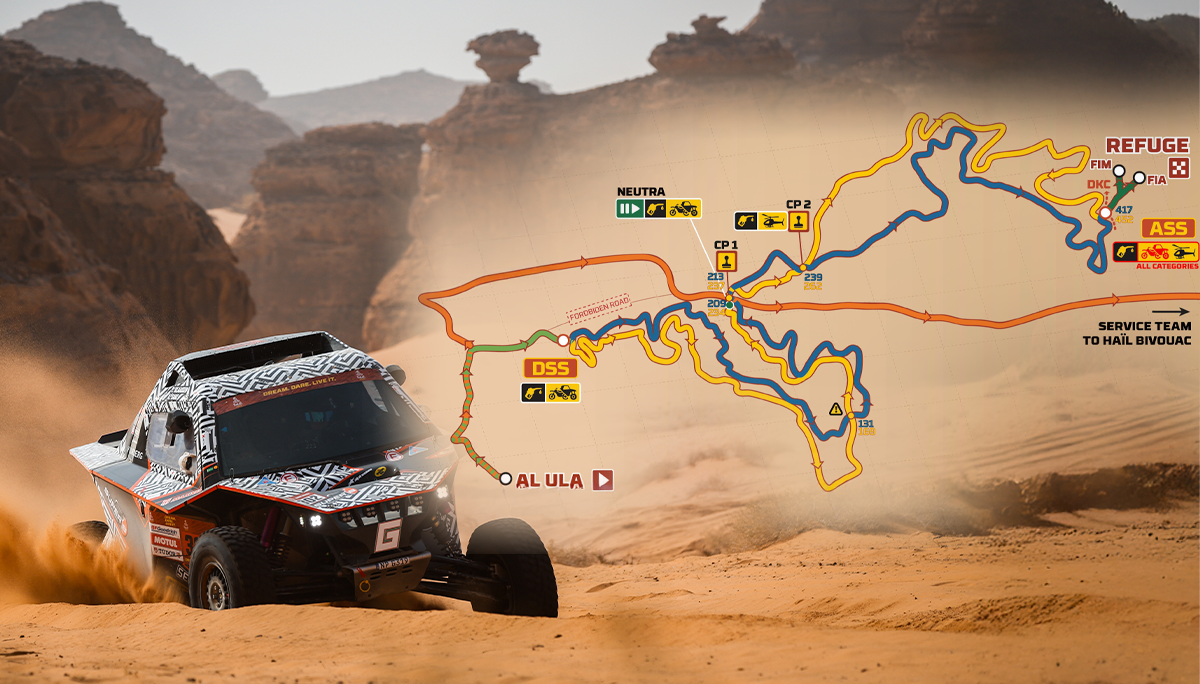
The total distance of Stage 4 is 530 kilometers, of which 452 kilometers count as the special stage. A 64-kilometer liaison leads to the start of the stage, followed by a short 14-kilometer liaison after the finish, heading to the dedicated marathon bivouac, known as Refuge Marathon 1. For the competitors, it will be an intense racing day that ends without the comfort of their regular mechanics.
Start times and daily schedule
The bikes depart early in the morning from the AlUla bivouac, with the first FIM competitors setting off at 06:00. Cars and trucks follow from 06:30. The timed stage begins at 07:30 for bikes and at 08:00 for the FIA categories. Due to the length of the stage and a neutralized zone during the route, the first competitors are not expected to arrive at the marathon bivouac until late afternoon.

Stage profile and characteristics
The route leads competitors deep into the AlUla region, continuing the varied terrain seen in previous days. The opening section consists of fast sandy tracks through canyons, often off the beaten path. Navigation is tricky here due to the large number of tracks and waypoints. After about one hundred kilometers, the landscape opens up to wide plateaus where speed can increase, though navigation becomes more challenging due to a lack of clear visual markers.
The mid-section includes several technical areas with rocky slabs, narrow passages, and trial-style sections. Frequent changes in rhythm are needed as the course winds between hills and rock formations. In the second half of the stage, wide sandy plains and undulating plateaus dominate, interspersed with demanding off-piste sections and rocky stretches. The final kilometers toward the marathon bivouac remain treacherous, with tight paths and technical obstacles demanding full concentration until the end.
Stage 4 opening riders and drivers
Tosha Schareina will be the first rider to open Stage 4 in the bike category. He will be followed by Ricky Brabec and Daniel Sanders, who also start early and are responsible for laying the tracks.
In the car category, Mitchell Guthrie will open the stage in his Ford Raptor. He will be followed by Martin Prokop, Guy Botterill, Lucas Moraes, and Cristina Gutierrez. Main contenders such as Carlos Sainz, Nasser Al Attiyah, Sébastien Loeb, and Henk Lategan will start further back, which adds extra strategic elements to this marathon stage.
What is a Marathon stage?
The 2026 Dakar Rally includes two marathon refuge stages: Stage 4 and Stage 9. During these stages, assistance from the team’s own service crew is prohibited. Competitors are only allowed to help one another. Repairs and maintenance must be performed by the drivers themselves or with help from fellow competitors.
The overnight stay takes place in a designated marathon bivouac with minimal facilities. Participants receive tents, rations, and basic amenities such as water and a campfire. There are no team trucks, no extensive catering, and no mechanics present. This format emphasizes self-reliance, vehicle management, and tactical driving, since damage or mechanical issues can directly impact the next stage.
For Stage 4, two separate bivouacs have been set up: one for FIM competitors and one for FIA participants, highlighting the solitary nature of this marathon day.
A decisive day in week one
Stage 4 is considered one of the key stages in the first week of Dakar 2026. Not only because of the distance and terrain, but especially due to the marathon format. Those who take too many risks here may pay a high price.