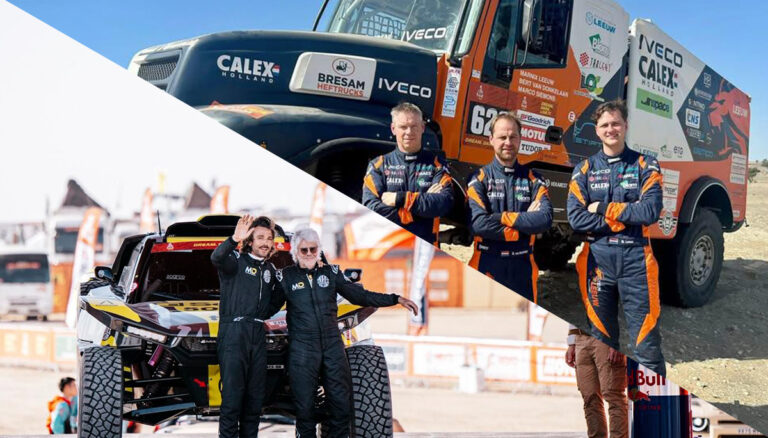
After the rest day in Riyadh, the Dakar Rally 2026 enters its second and decisive week. Stage 7 marks a tough restart, taking the competitors from Riyadh to Wadi Ad Dawasir. It is a long and predominantly fast stage where the pace is high from the start, but where navigation, concentration, and endurance once again play a crucial role. The rest day offers no guarantee of a gentle return to racing.
The total distance of Stage 7 is 877 kilometres, of which 459 are against the clock. The day begins with a 278-kilometre liaison from the bivouac in Riyadh to the start of the timed special. After the special stage, another 140-kilometre liaison brings the competitors to the bivouac in Wadi Ad Dawasir. With this structure, the stage becomes a particularly long racing day, with arrivals expected well into the evening.
Start times and day structure
The motorbikes leave the Riyadh bivouac first at 04:00. The cars and trucks follow from 06:10. After the long morning liaison, the timed special begins for the bikes at 07:55. The FIA categories begin their special at 10:05. The schedule is tight, but due to the stage length and neutralisation zones, the field will be widely spread at the finish.

Character of the stage and key features
Stage 7 is a fast, southbound route that immediately sets the tone for the second week. The stage begins in wide valleys with well-defined, high-speed tracks. Up to the first checkpoint, speeds can be very high, but the many parallel tracks make navigation tricky.
Next comes a long erg where the pace naturally drops and precision becomes more important than speed. After this sandy section, the speed picks up again toward the second neutralisation, though navigation remains key due to the large number of intersecting tracks. In the final part of the stage, the tracks begin to disappear and off-piste sections dominate. The terrain becomes rockier, the canyons narrower and the dust increases. Only in the last few kilometres approaching the assistance zone does the pace rise again, though the organisers warn of deceptive dips and hidden obstacles.
The surface is highly varied. Roughly sixty percent consists of dirt tracks, complemented by sand, dunes and stony trails. Asphalt plays no role in the special stage itself. Several caution zones are included, notably at broken dunes, barely visible rocks and narrow rocky passages.
Stage 7 openers
In the motorbike category, Ricky Brabec will be the first to start the special, followed by Tosha Schareina and Daniel Sanders. Skyler Howes, Adrien Van Beveren and Luciano Benavides are also among the early starters, taking on the difficult task of laying the tracks in a stage where navigation may once again be decisive.
In the car category, Nasser Al Attiyah is the first to leave in his Dacia Sandrider. He is closely followed by Sébastien Loeb and Seth Quintero, with Toby Price, João Ferreira and Nani Roma also departing early. Big names like Carlos Sainz, Mattias Ekström and Henk Lategan will also start in the front part of the field, making for an exciting opening phase.
Key restart to the rally
Stage 7 is seen as a pivotal moment after the rest day. The high pace, long distance and complex navigation make this stage a potential trap. Those who fail to find the right rhythm immediately could lose valuable time. At the same time, it offers a clear opportunity for competitors who return fresh and are able to drive with control and precision.