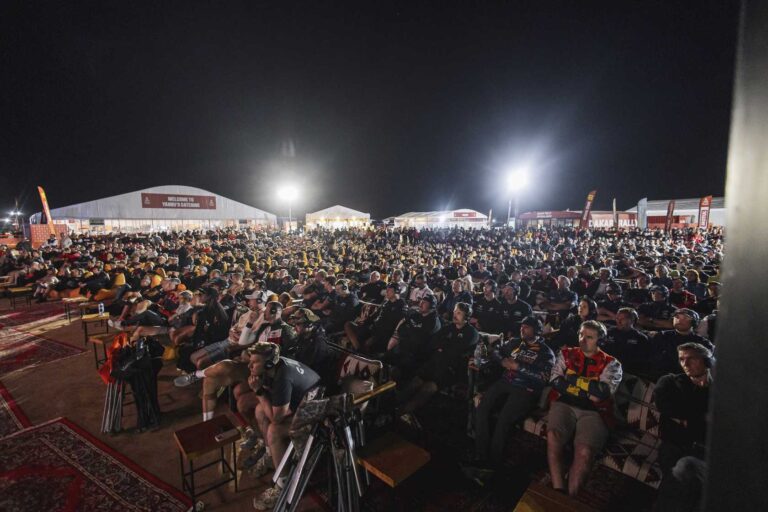
Tomorrow, the 48th edition of the Dakar Rally starts in Yanbu, Saudi Arabia. Teams are busy today with final tests and inspections, but fans at home are also making their final preparations. So how do you best follow the Dakar Rally?
The latest news
During the stages, the Dakar Rally posts a lot of information in the Race Center. The information here ranges from start times to stage winners, but also riders in trouble or route adjustments are shared here.
We at RallyTracks.nl write a daily update for all categories. As soon as the first motorcycles or cars reach the finish, the team begins writing a report containing the day’s news for that category. Later we supplement this with more information and of course the latest news about Dutch participants.
In addition to daily reports, we also preview tomorrow’s stage, share and write other updates about the Dakar Rally. In short, don’t miss anything from the Dakar Rally on RallyTracks. We share all our items in our WhatsApp Group, Facebook and Instagram. Follow RallyTracks and stay informed during the Dakar Rally!
Live Timing
Besides the latest news and written content, there are also split times. All participants have a tracker on board, so the organization always knows who is where. But this is also used to send split times during the stage. This gives you a good picture of what’s happening throughout the day, you can see who is driving where and you can quickly see that something is wrong, sometimes even before the Dakar Rally shares it themselves in their updates.
Dutchman Mischa Visser built trackingdakar.com 25 years ago, on his website you can easily see the times in a clear overview. For the editorial team, this is perhaps the most important website during the rally. You can see how the rally is progressing at a glance per category, you can mark your favorites and access information in different ways. So definitely take a look here if you want to see how the rally is going that day.
What do all those terms actually mean?
During the rally you hear many different terms, let’s explain them. Because some terms even have multiple meanings.
Prologue: This is actually stage 0 of the Dakar. The prologue is a short stage (often 10-30 kilometers) that doesn’t count for the classification, but does determine the starting order for the first real stage. The fastest riders in the prologue get to start first, which is often a disadvantage because they have to ‘open’ the route and make tracks in the sand.
Stage: A stage is a daily race section of the rally. The Dakar consists of multiple stages (this rally has 13), with each stage meaning a full day of driving. A stage consists of different parts: a liaison section to the start point, the actual special (the timed section), and often a liaison section to the bivouac.
Special (or Timed Section): This is the actual timed competition section of a stage. Only the time you drive in the special counts for your classification. The special can vary from a few dozen to hundreds of kilometers.
Liaison: The non-timed section between the bivouac and the start of the special, or between the end of the special and the next bivouac. Here participants must arrive within a maximum time, but the exact speed doesn’t count.
Bivouac: The temporary camp where all teams come together at the end of each stage. Here vehicles are serviced, repairs are carried out and the teams sleep. The Dakar Rally even starts with a special Start Camp in Yanbu that is larger and more extensive than all other bivouacs during the rally. Each bivouac has tents for the organization, but also a medical tent and a large catering tent.
Marathon Stage: A special stage setup where riders must drive two consecutive stages without help from their assistance team. After the first marathon stage, participants overnight in a closed bivouac where only the riders and navigators themselves may work on their vehicle. This tests not only driving ability, but also the crew’s technical knowledge and the reliability of the equipment. This Dakar Rally has two, namely stages 4/5 and stages 9/10.
Waypoint – Navigation: In navigation, a waypoint is a specific coordinate point in the roadbook that riders must reach or pass. These are often control or reference points that indicate where they should drive. They are physical locations that are programmed into the navigation system and through which riders must navigate to follow the correct route. There are different types and you receive a time penalty for missing a waypoint. Each stage also has a maximum number of waypoints you can miss without being disqualified.
Waypoint – Live Timing: In the live timing context, waypoints are specific measuring points along the course where participants’ times are recorded. These are virtual timing points (often multiple per special) where split times are recorded. These waypoints give spectators and teams insight into the standings during a stage. You see this reflected as “WP1”, “WP2”, etc. in the live results on websites like trackingdakar.com.
Checkpoint: A physical stamp post along the course that participants must pass through. At a checkpoint, riders must have their passage registered, often by getting a stamp in their roadbook or through electronic registration. Missing a checkpoint results in a heavy penalty, sometimes even disqualification. Checkpoints are used to verify that participants follow the prescribed route and don’t cheat by cutting corners.
Roadbook: The navigation booklet that each rider receives containing circles and arrows (direction indicators), distances, waypoints and warnings for hazards. This is the navigation instrument of the rally. In the past, participants received this the evening before the stage, nowadays they drive with a digital roadbook. In the bivouac they receive an unlock code, with which they get the route to the start. Once in the start area, the roadbook for the stage is automatically loaded. This way everyone has the same preparation time and the role of the navigator becomes increasingly important.
Sportity: The official bulletin board of the Dakar Rally organization. All official documents appear here such as starting order, results, classifications, decisions from race control (stewards), penalties, information about access and parking for teams and press, and procedural announcements. For everyone who follows the rally professionally, Sportity is indispensable.
Neutralization: A temporary suspension of the race, usually for safety reasons (bad weather, accidents) or logistical reasons. Time during a neutralization doesn’t count for the classification. A special can also have one or more neutralizations, then there’s a piece of liaison in the special. This can be because they have to cross asphalt or pass a vulnerable area.
Penalty: The organization can hand out multiple penalties, including time penalties that riders can receive for violations such as starting too early, driving too fast in liaison zones, missing waypoints or unsporting driving behavior. Penalties are issued by race control and published via Sportity.
ASO (Amaury Sport Organisation): The organizer of the Dakar Rally. This French company also organizes the Tour de France and other major sporting events.