


This year the Morocco Desert Challenge starts in Ouarzazate and takes competitors across four distinct dune fields. That means not only vast stretches of sand, but also technical sections where precision and concentration are decisive. Combined with fast pistes and constantly changing surfaces, the result is the setting for ten intense days of competition.
Strong and diverse entry list
Interest in the Morocco Desert Challenge continues to grow. At present, 155 vehicles are already registered. In the car category, 62 competitors are confirmed. The field includes multiple Overdrive Toyotas, Red Lined vehicles, Century prototypes, and MD buggies. Classic rally icons will also line up at the start, such as the Toyota HDJ80, Mercedes G, and Mitsubishi Pajero EVO. Notably, almost half of the entered cars compete in the T1+ category, underlining the high performance level and strong expectations.
The SSV category counts 52 confirmed vehicles, once again making it the largest class in the rally. All major brands are represented, including Polaris, Can Am, Taurus, Arcane, and Yamaha. The field is also highly international, with teams from across Europe and beyond.
The motorcycle category features 35 riders, with strong representation from the United Kingdom, the Netherlands, Belgium, and France. In addition, six trucks are currently entered, with expectations that this number may increase further.
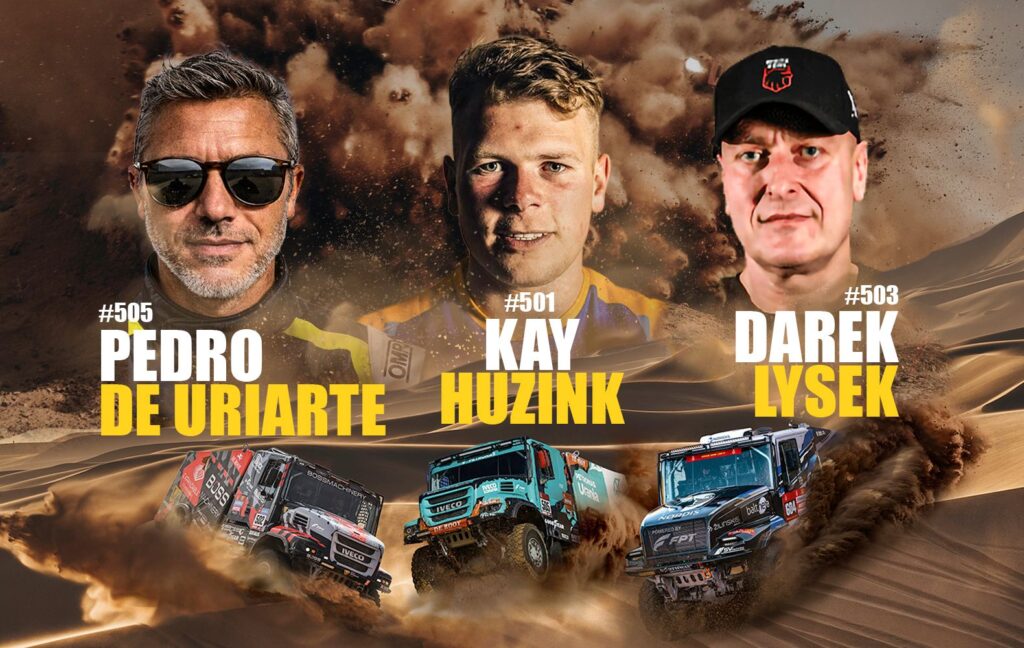

Team De Rooy enters three trucks
One of the most eye-catching announcements is the participation of Team De Rooy FPT. The Dutch squad will field three Iveco Powerstar trucks in the eleventh edition of the Morocco Desert Challenge.
Polish driver Darek Lysek, who finished eleventh in the previous Dakar with an MM Technology truck, switches to the winning Iveco of Team De Rooy. The team’s strong performance in the 2026 Dakar Rally certainly influenced that decision. The second truck in the De Rooy lineup comes from Mexico. Pedro De Uriarte and navigator Eduardo Vanzzini previously competed on four wheels in the T1 class. De Uriarte also raced Dakar on a motorcycle and now steps up to the demanding truck category.
The biggest surprise, however, comes from the Netherlands. Kay Huzink, winner of the truck classification in the 2025 Morocco Desert Challenge and a recent Dakar stage winner with seventh place overall, will trade his familiar Renault for an Iveco from Team De Rooy for this rally. According to team manager Henk van Leuven, the Morocco Desert Challenge is not only sportingly attractive but also an ideal environment to introduce new drivers to the team and to evaluate emerging talent.
Roadbooks under the supervision of Sébastien Delaunay
Another key development is the involvement of Sébastien Delaunay in the validation of the roadbooks. The experienced navigator has competed in the Dakar Rally seventeen times and built an impressive record in the World Rally Raid Championship.
Delaunay is active in the World Rally Raid Championship and has competed alongside Dania Akeel in a Toyota Ultimate. He has also written roadbooks for more than fifteen rallies and served as sporting director at several events in Morocco. His experience and strong focus on safety and accuracy are expected to contribute to a high quality and reliable route. With his sharp eye for speed and the performance of modern vehicles, he aims to help create stages that are both safe and challenging.
SSV category continues to expand
With 52 entries, the SSV category confirms its dominant position within the Morocco Desert Challenge. Major service teams such as South Racing, RZR Racing, Buggy Masters, Peake Motorsport, and Overlimit will once again be present.
A strong Dutch presence stands out. Teams such as Shiver Offroad and Van Eerd Racing each field four vehicles, while the Brabant based QFF Racing enters no fewer than fifteen SSVs.
The class structure is divided into four main categories: SSV Open Light with a maximum speed of 120 kilometers per hour, SSV Open up to 125 kilometers per hour, T4 and T3 with a maximum of 135 kilometers per hour. New additions include two separate Can Am Cups within the T4 category, reflecting the high number of this brand in the field. In addition, the new T3 Experimental category is introduced, intended for powerful prototypes such as the new Taurus equipped with a 1600 cubic centimeter turbo engine.

