
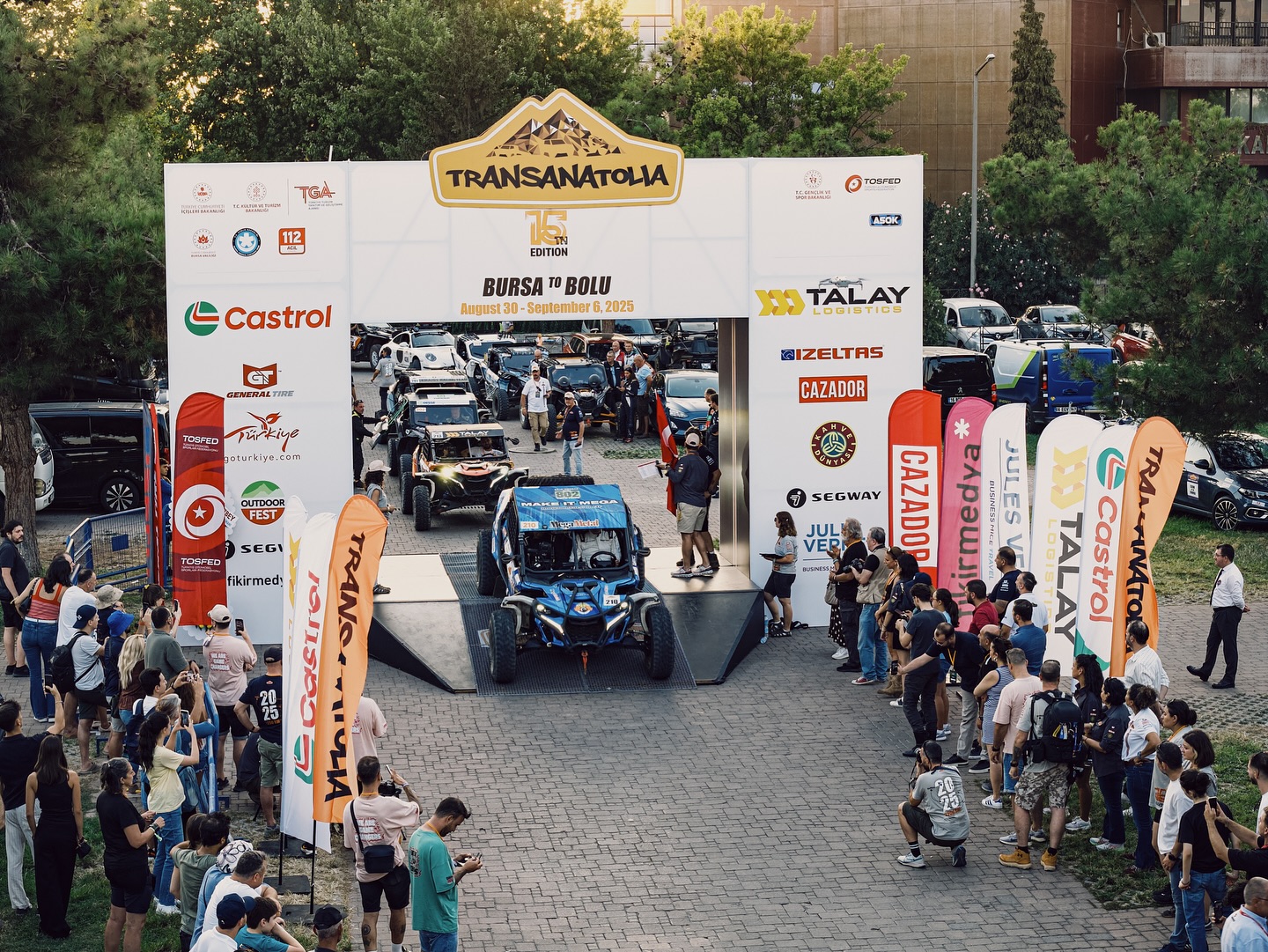

Turkey will host a revamped edition of the Transanatolia Rally in 2026. Organiser Transanatolia Spor Organizasyonları has announced that the rally will run from 29 August to 6 September through central and northern Turkey. The route covers around 2,300 kilometres, of which approximately 1,400 kilometres are timed. Competitors will work their way across the country over nine days.
The rally is open to a wide range of classes. On the car side, these include Ultimate, Stock and classics, supplemented by Challenger and SSV buggies. Trucks, quads and bikes are also eligible. For bikes there are five categories: single-cylinders above and below 450cc, and three classes for twin-cylinders (up to 650cc, between 650 and 1,000cc, and above 1,000cc). That breakdown aligns with what many competitors actually ride, including the popular Yamaha Ténéré 700 and Ducati DesertX Rally, both of which have appeared at the Turkish start in recent years.
From the Black Sea to Cappadocia
The route begins in Istanbul and heads north towards the Abant Gölü National Park near Bolu, where the first night under the stars takes place on 30 August. From there the field moves on to the Black Sea port city of Zonguldak, making its debut on the route. Via the Ilgaz mountain range, competitors continue to Kastamonu (1 September) and then on to the historic city of Tokat (2 September), situated at the confluence of the Tokat and Yeşilırmak rivers and overlooked by an impressive castle.
From Tokat the rally turns south into the semi-desert region of Cappadocia, world-famous for its cone-shaped rock formations known as fairy chimneys, and offering demanding off-road terrain. Two nights are spent here (3 and 4 September). Along the way the field passes through Aksaray, once an important stopping point on the Silk Road. The final day runs past the salt lake Tuz Gölü, Turkey’s second-largest lake and known for its flamingos, before the finish in the capital Ankara on 5 September.
According to general coordinator Burak Büyükpınar, a deliberate mix of overnight arrangements has been chosen. Competitors will sleep partly in a traditional bivouac and partly in hotels in the cities along the route.
A rally with history and an ever-changing character
The Transanatolia is no newcomer. The first edition was held in 2010 and was considered one of the most ambitious events in the region at the time. In 2012, Büyükpınar and Orhan Çelen established a new organising team, expanded in 2014 with Necati Şahin, the year Ankara served as both start and finish. Last year Ahmet Ağaoğlu joined the board. The rally is organised with the approval of the Turkish motorsport federation TOSFED.
What stands out is how significantly the event changes from year to year. The route is almost never repeated: in 2022 it ran from Hatay to Eskişehir, in 2023 from Samsun to Izmir, and in 2024 from Mersin on the Mediterranean coast to Van in the far east. Earlier editions started and finished in the tourist city of Antalya. The 2026 edition, departing from Istanbul and looping through the north and centre of the country, is once again a complete overhaul. That constant reinvention is a double-edged sword: it keeps the rally fresh for returning participants, but makes it harder to build a recognisable identity and a stable field of competitors.
The sporting level has been serious over the years. The 2020 edition was a scaled-down, Covid-affected event with just 25 bikes riders, but still featured names such as Adrien van Beveren and Xavier de Soultrait. In 2023, 122 competitors from thirteen countries lined up at the start. That same year also illustrated the vulnerability of a rally so dependent on terrain and weather: a devastating flood in the start city of Samsun forced the organisation to cancel the opening stage.
The ambition is clear: the organisation wants to develop the event into one of the toughest and most popular rallies in the world. That is a bold statement on a busy international calendar, where the FIA World Rally-Raid Championship (W2RC) with the Dakar, Abu Dhabi and Portugal attracts most of the top riders and factory teams. The Transanatolia positions itself more as an accessible adventure for both experienced riders and amateurs, which also explains the separate, less competitive Raid format alongside the full competition classes.
Entry fees and costs
The rally is supported by, among others, Castrol, TOSFED, General Tire, Jeep and Fiat. Entry fees for the competition class are 4,100 euros for bikes, 6,700 euros for cars and 6,900 euros for trucks. Those opting for the Raid format pay 3,500 euros (bikes) or 6,000 euros (car). Guests wishing to follow the event in their own vehicle can do so for 2,400 euros, or 2,800 euros in an organisation vehicle.
For Dutch and Belgian rally riders looking for a multi-day, scenically challenging adventure outside the world championship circuit, at a price well below a Dakar entry, the Transanatolia remains an interesting option on the late-summer calendar. Whether the revamped northern route will also attract a larger and more international field of competitors is something the 2026 edition will have to prove.

