
A short, dusty prologue at Kastoria airport got the Baja Greece 2026 underway on Thursday evening. The event around Argos Orestiko in Western Macedonia carries double weight this year: it is the third round of the FIA World Baja Cup and the second round of the FIA European Baja Cup.
Nineteen vehicles are entered in the FIA competition, spread across the Ultimate, Challenger, SSV and Stock classes. It is a compact field, but one with several familiar names. Overdrive Racing brings Saudi Arabia’s Dania Akeel to the start as one of the favourites for the world standings, while veteran Lionel Baud (X-Raid, Mini JCW Rally) and Benediktas Vanagas (Toyota GR DKR Hilux EVO T1+) are among the expected frontrunners. The Challenger class includes Hamed Al Wahaibi, Abdulaziz Alkuwari and Dutchman Mitchel van den Brink, among others.
Baud sets the fastest time
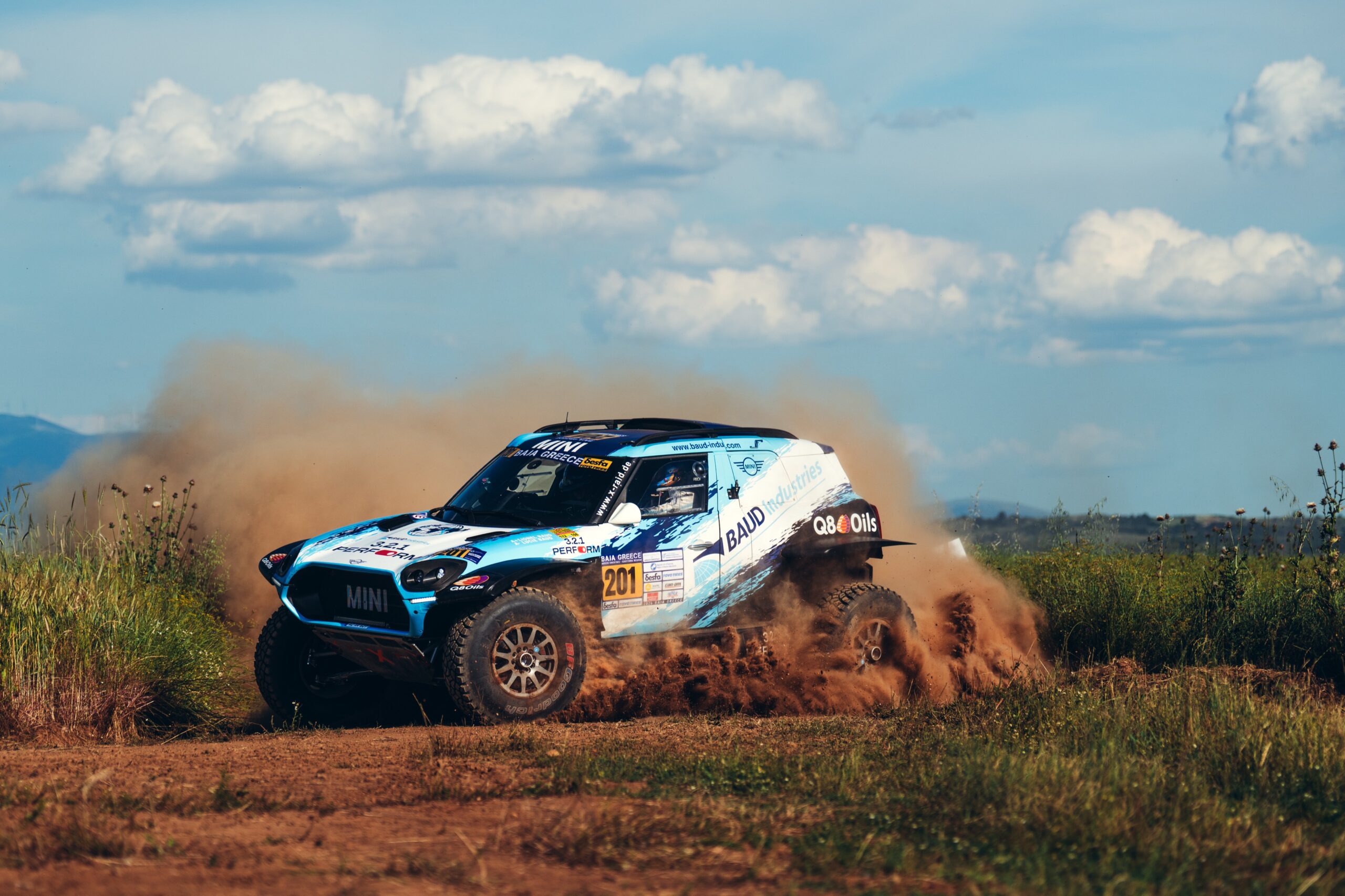
Over the tight six-kilometre-plus prologue, it was Lionel Baud who set the tone alongside navigator and daughter Lucie Baud. The French duo clocked 3:53.9 to lead the entire field. Al Wahaibi, with Polish navigator Maciej Giemza in his Taurus Evo Max, finished 3.6 seconds back in second and was the fastest in the Challenger class.
The prologue top six:
- Lionel Baud / Lucie Baud (Mini JCW Rally) 3:53.9
- Hamed Al Wahaibi / Maciej Giemza (Taurus Evo Max) +3.6
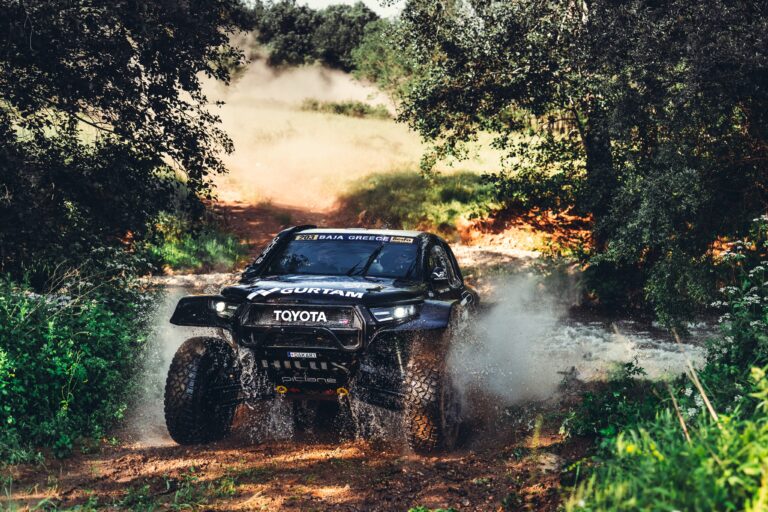
- Benediktas Vanagas / Aisvydas Paliukenas (Toyota Hilux) +5.1
- Karel Trneny / Vaclav Pritzl (Ford F150 Evo+) +8.4
- Abdulaziz Alkuwari / Max Delfino (Taurus Evo Max) +8.6
- Dania Akeel / Sebastian Delaunay (Toyota Hilux Evo) +10.2
Notably, world cup favourite Akeel had to settle for sixth. The gaps are small, but the prologue covers barely any distance.
Van den Brink steps up to a new class
For Dutch followers, the move by Mitchel van den Brink is worth watching. With navigator Bart van Heun, he won the SSV class at Baja Greece in both 2024 and 2025. This year the duo competes in the Challenger class in a Can-Am Maverick R. Van den Brink set the seventh fastest time in the prologue, good for third within Challenger behind Al Wahaibi and Alkuwari. A deficit of just over ten seconds means little over this distance, but it does show that the step up to the new class is immediately competitive.
Vanagas stalls the engine yet still leads the European standings
Third place went to Vanagas and Paliukenas, despite an unfortunate opening. Vanagas locked his wheels almost immediately after the start in a tight hairpin and stalled the engine. According to the team, the mistake was a consequence of the narrow Greek tracks and the adapted anti-lag system, which cuts power under heavy braking to improve manoeuvrability in tight corners but causes a brief loss of drive. Third place was still enough to make Vanagas the fastest European championship contender, and he takes the lead in the FIA European Baja Cup.
What the prologue does and does not mean
The prologue times do not count towards the overall classification. They determine solely the starting order for the proper stages on Saturday and Sunday, with the ten fastest choosing their starting position for the first stage. The real competition begins now.
According to the official roadbook, competitors face a total route of 806 kilometres, including over 600 kilometres of timed stages run almost entirely on gravel. The stages climb to nearly 1,900 metres and this year venture onto the new terrain of the Grammos alongside the familiar slopes of Vitsi. The organiser describes it as likely the longest event on both FIA calendars.
With narrow mountain passes, little room for error and the expected Greek heat, managing temperatures and avoiding mechanical problems may prove just as decisive as outright speed. The first stage takes place on Saturday, with the outcome decided on Sunday in Argos Orestiko.