
The second stage of the Baja Morocco, named La Momie, took competitors 298 kilometres further into the Moroccan interior on Friday. The organisers described the day as difficult across the board: the piste was poorly visible from the start, and towards the end of the special the competitors crossed their own tracks from earlier in the day several times.
Afterwards it also became clear exactly what lay behind the striking time bonuses and penalties of the opening stage. Century Racing reported on behalf of Brian Baragwanath and Jayden Els that part of the field had been stopped on Thursday by a sandstorm, after which the times of the affected crews were compensated. Baragwanath and Els themselves were handed a fifteen-minute penalty for missing a waypoint, the team stated: “a 15min penalty to Jayden and Brian for missing one waypoint”. That explains why the South Africans, who had set the fastest time of the entire opening stage on the clock, still ended up third in the corrected results.
After two stages Noa Sainct holds a comfortable lead in the bikes, Mathieu Serradori has taken over the lead in the cars from Simon Vitse, and Adrien Choblet is the new leader in the SSVs at the expense of Manuel Andújar.
Sainct extends his lead, strong day for Bretez
Sainct set the fastest time on the second day as well, in 5:37:21, and benefits above all from being the only rider in the field yet to receive any time bonus or penalty. Behind him, Boris Bretez posted the second time of the day, at 30:54, a strong response after the penalty that had set him back on the opening day. Teammate Franck Verhoestraete was third at 31:21, 27 seconds behind Bretez, and still stands second in the overall classification, at 50:14 from Sainct. Thanks to his stage time, Bretez moves up to fifth in the overall standings.
Louis Trelluyer, third after the first stage, set the fourth time of the day and also remains third in the overall standings, ahead of Thomas Kongshoj and Christopher Jautard. Richard Hodola was handed a penalty for the second stage running, this time of fifteen minutes, and sits at 2:33:42 from Sainct in the overall classification, which does nothing to change his seventh place. Further down the standings, Gaetan Alengrin and Benjamin Defrère swapped places: Defrère received a 3:27 penalty for the second stage and drops just behind Alengrin to eleventh.
Serradori takes the lead, strong return for Van den Brink
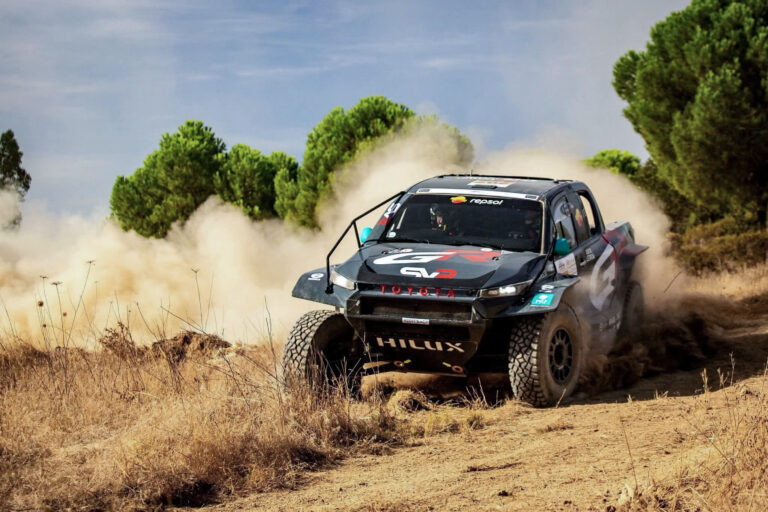
Among the cars, the second stage turned the order around. Simon Vitse and Delphine Delfino did set the fastest time of the day in the MD Optimus Evo5 with 4:37:08, closely followed by Mathieu Serradori and Loïc Minaudier in the Century CR7 at 46 seconds. In the overall classification, however, it is Serradori who takes over the lead, with 10:21:04 against 10:41:49 for Vitse, a gap of 20:45.
Behind the two Frenchmen, Rik van den Brink set the third time of the day, at 16:25 from Vitse. Starting as the last car after his retirement on the opening day, he came back to third within his class and even to the fifth fastest time of stage two across all categories, after Vitse, Serradori and the SSVs of Alexandre Pinto and Andréa Deldossi. Because of the missed section of the opening stage, Van den Brink does not feature in the overall classification.
Daniel Beecroft and Phillip Gillespie set the fourth time in the Redlined Revo T1+ and also stand third in the overall standings, now at 1:04:04 from Serradori after a small correction. Dave Beecroft and Fraser Parish were handed a 45-minute penalty on the second stage and see their deficit grow to more than 4 hours 37 as a result. Jérôme Cambier and Antoine Lecourbe gave up the fight after the second stage.
Choblet to the SSV lead, Baragwanath tumbles after penalties
Among the SSVs it was the day of the Portuguese pair Alexandre Pinto and Bernardo Oliveira. They set the fastest time of the stage in BBR’s Odysée CR-X, in 4:44:30, ahead of Andréa Deldossi and Jérémy Tricaud at 4:46 and Baragwanath and Els at 10:44.
In the overall classification after two stages, however, Adrien Choblet leads. The Casteu Trophy Frenchman, winner of the opening stage, set only the sixth time of the day himself but retained enough margin to keep Pinto at 8:23 behind him. Manuel Andújar, winner of the opening stage, drops to third, at 23:50 from Choblet, with Baragwanath and Els right behind in fourth at 25:38. Of the forty SSVs on the provisional entry list, eighteen appear in the overall classification after two stages.
The second stage also saw five retirements. Alongside Cambier in the cars, the SSV class lost Pierre Marie Bergeret and Victor Papot, Lorinc Meszaros and Albert Horn, Michele Cinotto and Guido Novaro, and Stéphane Corrand and Laetitia Boulloud. For BTR, the largest team in the field with seven entered Can-Ams, that meant losing two of its crews.
Mathieu Serradori also used the special to continue testing with the Century CR7. With regular navigator Loïc Minaudier, the team slightly adjusted the shock absorber settings compared with the opening day. Serradori stressed afterwards the importance of the collaboration with Century Racing and of the routine with Minaudier: “On se connaît, on se fait confiance et chacun sait pouvoir compter sur l’autre.” His team analyses the findings after every stage to fine-tune further for the next day, in what he emphatically calls preparation for later races.
Van den Brink and Heimans back up to speed
Rik van den Brink and Gydo Heimans recovered strongly from their problems on the opening day. After the power of their Century CR7 proved not to be in order on Thursday and they had to stop the special, they set off on Friday as the last starting car. The result was the third time among the cars and the fifth fastest time of the day across all categories. Their team Brinky Rallysport reported afterwards: “A big smile today.” Gydo further described the special as bumpy, rugged and navigationally tricky, with fast sections in between, and spoke of “a fifth time after starting at the back,” plenty of dust and overtaking moves.
Saturday: special shortened after flooding
The third stage was initially planned as the toughest of the week: a selective section of 380 kilometres with a route through the area to the west and southwest of Merzouga, good for a total of 428 kilometres.
On Friday evening, the race management informed all competitors via a bulletin that the special has been shortened to 263 kilometres because of flooding in the western part of the special. In the new set-up, competitors first drive 138 kilometres to a neutralised refuelling point of thirty minutes, followed by a loop of 20 kilometres back to a second, ten-minute neutralisation at the same spot, after which the final hundred kilometres of the special follow. Because the assistance point lies far from the route, the organisers chose to announce the change in advance so that teams could adjust their logistics.
(The stated standings are the provisional classifications published by the organisers after two stages, including time bonuses and penalties. All results may still change.)