
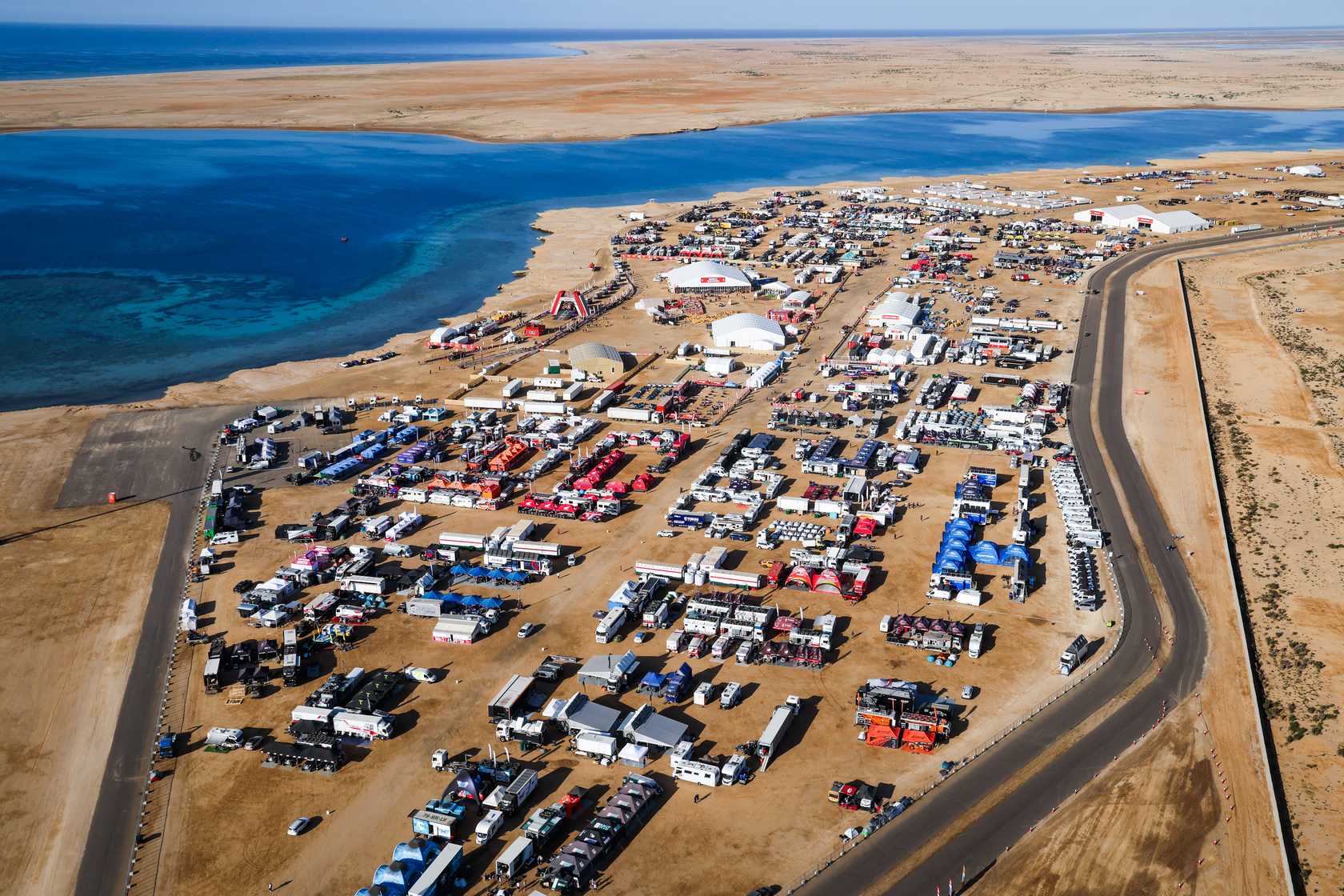

The ongoing tension in the Middle East now reaches deep into international motorsport. Where Formula 1 already cancelled races in the Gulf region this spring and the WRC season may not conclude in Saudi Arabia, uncertainty is also growing in the rally raid world. The Dakar Rally, fully anchored in Saudi Arabia since 2020, is still scheduled for 1 to 15 January 2027. Behind the scenes, however, teams, drivers and insurers are weighing the risks ever more carefully.
For the Dutch competitors, who are traditionally strongly represented in cross-country, this raises concrete questions. Continue preparing for Saudi Arabia, wait and see how things develop, or switch to an alternative such as the Africa Eco Race? The first decisions have now been made, and the answers vary widely. Here we lay out the situation.
A region under strain
The concerns do not come out of nowhere. In the first half of 2026, the conflict between the United States and Israel on one side and Iran on the other escalated, after which several Gulf states, including Saudi Arabia, became targets of Iranian missile and drone attacks. Since the summer, the Houthis have also resumed attacks from Yemen on Saudi territory and on shipping in the Red Sea.
The Dutch Ministry of Foreign Affairs currently maintains an orange travel advisory for Saudi Arabia, which amounts to essential travel only. For the border area with Yemen, code red even applies. The ministry also explicitly warns of possible missile and drone attacks. That this threat is not theoretical became clear on 24 August, when the Houthis reported having struck a Saudi oil tanker roughly 117 kilometres off the coast of Yanbu. It is precisely this Red Sea port city that lies on the route of the Dakar 2027, where competitors finish the first stage and set off again a day later.
Motorsport shifts ground
Rally raid does not stand alone in this matter. Formula 1 already scrapped the Grands Prix of Bahrain and Saudi Arabia back in March; the race in Bahrain was moved to Malaysia, while Jeddah disappeared from the calendar entirely. The closing races in Qatar and Abu Dhabi are also under pressure, and the F1 organisation and FIA are taking into account the possibility of concluding the season in Europe if necessary. A decision on this is expected around mid-September. The World Endurance Championship likewise moved its rounds in Qatar and Bahrain to Barcelona and Monza, and MotoGP postponed the race in Qatar.
Most telling for the rally world is the uncertainty surrounding the WRC finale. The Rally of Saudi Arabia, scheduled in Jeddah in the second half of November, counts as the fourteenth and final round of the world championship. In early September, works teams Toyota and Hyundai confirmed in a joint letter to the FIA that internal, company-wide travel restrictions for the Middle East currently prevent their staff from travelling. M-Sport added a caveat: team boss Richard Millener pointed out that the official travel advisory is limited to a ten-kilometre strip along the border with Yemen, and stressed that the safety of the team remains paramount.
The FIA says it continues to work on a solution and has to date not cancelled, postponed or suspended the rally. The logistical deadline is approaching, however: a definitive decision is expected around mid-September, possibly as early as the start of next week. If the finale cannot take place in Saudi Arabia, Portugal is circulating as the primary alternative, with the gravel rally Six Cities North already on the calendar as the ERC closing round anyway.
Dakar sticks with Saudi Arabia
Against that backdrop, organiser A.S.O.’s course stands out. In May, the French organisation presented the Dakar 2027, the 49th edition, with start and finish in King Abdullah Economic City on the Red Sea. At 8,390 kilometres, of which 5,320 kilometres of timed special stages, it involves the most competitive kilometres of all Saudi editions to date, supplemented by two marathon stages. Managing director Yann Le Moenner acknowledged at the time that the geopolitical situation raises questions, but pointed to a stable and committed Saudi partner and to daily monitoring of developments. No plan B was announced.
Since May, however, the situation in the region has deteriorated further, while A.S.O. remains conspicuously quiet in public about the possible consequences for the rally. On the official channels, work simply continues towards the January edition, with a route that was made public unusually early this time. Several competitors note that a substantive response from the organisation to the current unrest has so far been lacking. Trucker Marnix Leeuw from Eindhoven, who has already entered, calls that absence of communication downright strange.
Division among the Dutch competitors
Among the Dutch entrants, the picture is divided. Ronald van Loon, who wanted to start in the cars, has decided not to go. The deciding factor was the safety of his team, but there was also a practical and financial problem: he could not get his equipment insured for the transport by ship to Saudi Arabia. William de Groot is also holding off on his participation for now and does not want to put his team at risk as long as the tension persists.
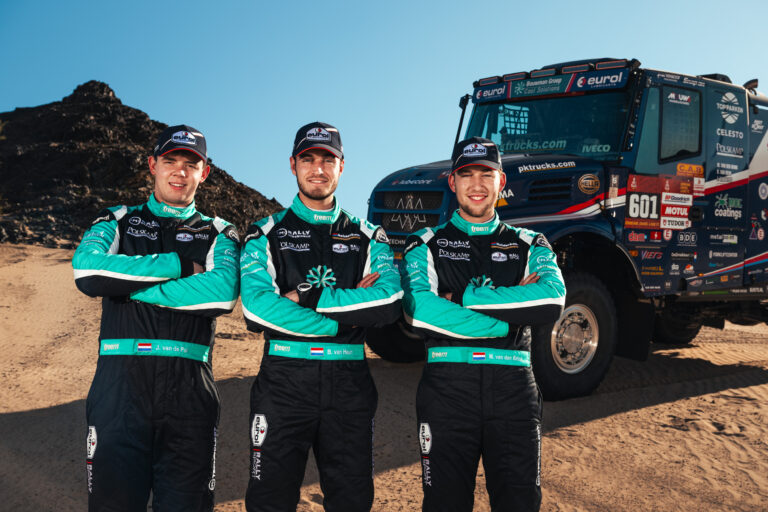
Other Dutch competitors are pressing on with their preparations. Navigator Arjan van Tiel from Venhorst is travelling out, but puts his finger on a sensitive spot by pointing to the role of the insurers. If they pull out, he argues, then it is game over for everyone. Truckers Marnix Leeuw, Janus van Kasteren and Michiel Becx have also entered. Dakar veteran Kees Koolen from Bergeijk, who has taken part sixteen times, considers it too early for conclusions. He trusts the organisation to make a sensible assessment and, for now, assumes the rally will go ahead, with the sober caveat that it could still change up to the last moment.
That division exposes what the Dakar is fundamentally about. Unlike a works team in the WRC, the largely privately operating cross-country crews bear the risks mostly themselves. It is not only about whether Saudi Arabia is safe enough, but also about whether equipment arrives in place on time, affordably and insured. In that respect, insurers may prove at least as decisive a factor as the sporting organisation.
The alternative: back to Africa
For competitors who are hesitant about Saudi Arabia, a logical alternative presents itself on African soil. The Africa Eco Race, reaching its 18th edition in 2027, follows the classic route from Tangier via Mauritania to Lac Rose near Dakar, far from the tensions in the Gulf region. The event, set up by Jean-Louis Schlesser and René Metge, explicitly presents itself as the heir to the original Paris-Dakar, with a stronger adventurous character and without world championship status.
The Netherlands has built up strong credentials there in recent years. In the 2026 edition, Gerrit Zuurmond won the truck class with his MAN for the second year in a row, while Martijn van den Broek, together with Mike Daas in a Can-Am, claimed the SSV classification. That makes the Africa Eco Race a realistic fallback scenario for Dutch teams, not only geographically but also competitively, if they want to secure their own desert adventure. There is no question of a mass shift at this point, however; it remains a different event with its own signature and its own position on the calendar. Still, RallyTracks can report from a reliable source that there are Dutch competitors and Dutch teams with Dakar ambitions who are nevertheless making enquiries with the Africa Eco Race.
An entry list that is shifting regardless
Geopolitics is influencing the composition of the entry lists along more than one line, moreover. As RallyTracks.nl reported earlier, in August the FIA lifted the restrictions on Russian and Belarusian competitors that had been in force since 2022. This leaves the door ajar for a return of crews such as KAMAZ in the FIA part of the sport, potentially including the W2RC and the Dakar, while the motorcycling federation FIM maintains its ban on riders for the time being. Whether that return actually takes place depends on the stance of organisers and on the legislation in the host countries, including applicable sanctions and visa rules.
The consequence is that the field of rally raid, quite apart from the safety question, could change in the coming seasons. From several directions at once, world politics is thus leaving its mark on a discipline that plays out precisely in the most remote places on earth.
What now?
The next milestones are close at hand. Both Formula 1 and the FIA are expected to take a decision around mid-September on their events in the Gulf region, with a decision on the WRC finale possibly coming as early as next week. The closing of entries for the penultimate WRC round in Sardinia has been pushed back for good reason, so that teams can make their choice with the question over Saudi Arabia in mind.
For the Dakar, the timeline is longer. The rally is not scheduled until early January, which gives A.S.O. room to await developments, but which at the same time prolongs the uncertainty for the competitors. After all, they have to commit money, staff and logistics now. The central tension can thus be summarised simply: the organisation’s contractual and commercial ties to Saudi Arabia set against the safety reality and the practical risks that the competitors themselves bear.
A move to another continent is not a realistic alternative on this timescale; a Dakar is simply too large to build up elsewhere within a few months. In the longer term, however, a more fundamental question arises: does the future of the rally lie solely in the Gulf, or will other deserts ever come back into view? That issue reaches beyond the upcoming edition.
RallyTracks.nl will return to it in more detail at a later time and will follow developments in the meantime, with a report as soon as concrete consequences for the calendar and the entry lists become known.

Comments are closed.