
The 2027 Dakar Rally will not be held in Saudi Arabia. Organiser Amaury Sport Organisation (ASO) and the Saudi Motorsport Company (SMC) confirmed this in a joint statement on Sunday 25 October. Because of the security situation in the Middle East, the 49th edition is moving to Europe and Africa. The full Dakar format is being retained, with a prologue, twelve stages and more than 4,000 kilometres of timed special stages. Saudi Arabia will get the rally back in 2028, for the 50th edition.
The rally does shift in the calendar: the prologue will be held on 9 January in Europe, after which the caravan transfers by ship to Africa. There, the first stage follows on 10 January. The finish is scheduled for 22 January.
With that, the Dakar returns to Africa for the first time since 2007. Exactly which countries it will involve and where the start and finish will be is not yet known. The official statement does not name a country either: according to ASO and SMC, the location will be announced separately in the coming days. ASO is waiting for official confirmation from the governments involved before doing so.
The official statement
In the statement, ASO and SMC speak of a decision taken in response to recent developments in the region. They emphatically call it an exceptional and one-off decision, taken in close consultation with the Saudi motorsport federation SAMF and with the support of the FIA and the FIM. The 2027 edition will go ahead and will be organised by ASO. According to the statement, ASO is in direct contact with competitors, teams and partners to guide them through the transition.
The decision does not mean a definitive farewell to Saudi Arabia. The country will host the 50th edition of the Dakar in 2028, and both organisations say they are already working together on it. Since 2020, Saudi Arabia has hosted seven consecutive editions. In the statement, ASO, SMC and SAMF confirm that they want to continue their long-running partnership.
What competitors know now
Teams and competitors were informed of the decision on Monday 19 October. In an update received by Dutch competitors, ASO’s plan is described as final. That update also contains the first practical planning: the first bivouac opens on 5 January and the technical and administrative scrutineering takes place from 6 to 8 January. According to the same message, there will be 4,300 kilometres of timed special stages.
Entry closes on 16 November, with extra time for payments and administrative processing. After the route presentation, a second newsletter will follow with logistical details and exact dates. The location of the rest day and the marathon stage have also not yet been announced.
A drastic change of course
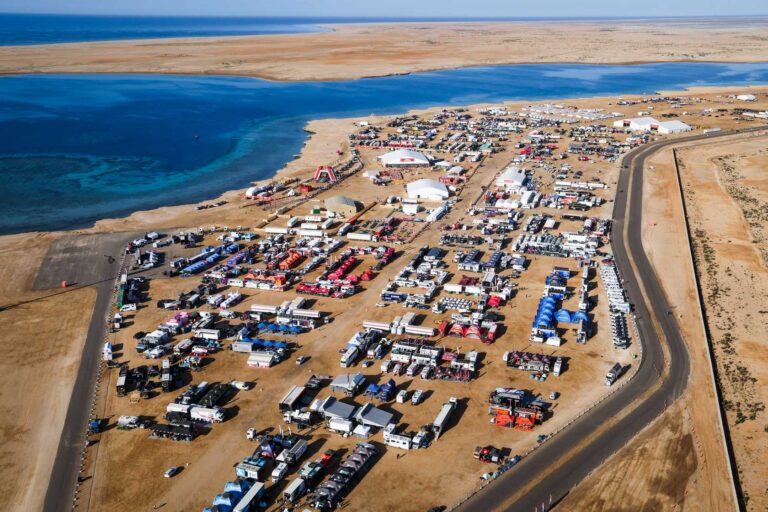
The decision runs completely counter to the plan ASO presented in Paris on 5 May. At that point, the assumption was still an eighth Saudi edition from 1 to 15 January, with the start and finish in King Abdullah Economic City on the Red Sea and a rest day in Bisha. With 5,320 kilometres of timed special stages, it would have been the longest Dakar of the Saudi era, and the first there above the 5,000-kilometre mark. ASO director Yann Le Moenner acknowledged at the time that the geopolitical situation raised questions, but stated that the organisation had guarantees that the rally could go ahead in Saudi Arabia.
The guarantees proved untenable. Since February, when the broader conflict surrounding Iran escalated, targets in Saudi Arabia and other Gulf states have been attacked. Later, the Houthi rebels from Yemen expanded their attacks to shipping in the Red Sea and the south-west of Saudi Arabia: the area where several southern stages of the original route were planned. Logistics also became more difficult, because vehicles and equipment are shipped from Europe via the Suez Canal and the Red Sea and insurers raised the premiums for that route. According to Speedweek, ASO was unable to find an insurer for the Dakar in September.
On 15 September, ASO still reported that preparations were proceeding according to plan. Two days later, the FIA cancelled the WRC round Rally Saudi Arabia, after Toyota and Hyundai indicated that their personnel could not travel to the country due to internal safety rules. The Formula 1 Grand Prix of Saudi Arabia had also already been cancelled earlier this year. In the weeks that followed, two scenarios circulated in the international press: a Saudi route shifted to the north, or a move to Africa. One of the variants discussed assumed a prologue on the Iberian Peninsula and only eight stages in Morocco. In the end, a full edition of twelve stages was chosen.
Contract, name and the 50th edition
ASO and Saudi Arabia have a contract that runs through 2029. That the move is happening in consultation with Saudi Arabia, as the Argentine outlet Cadena 3 reported earlier, is now official with the statement: ASO and SMC took the decision jointly. By treating the 2027 edition as a one-off exception and assigning the 2028 anniversary edition to Saudi Arabia, the partnership remains intact.
According to the Catalan newspaper Ara, it was uncertain for a long time whether the rally could keep the name Dakar outside Saudi Arabia, because of commercial agreements with the country. That name is being retained: the statement explicitly speaks of Dakar 2027.
Points to note
The most important question for now is: where exactly? Spanish and Argentine media name Spain as a possible location for the prologue and Morocco as the country where the organisation is working on the route, but neither has been officially confirmed. The joint statement from ASO and SMC also leaves the location open, but Portugal is a candidate too. Teams therefore have to enter, budget and arrange shipping without knowing the countries. On top of that, there are fewer than seven weeks between the close of entries and the opening of the first bivouac.
In addition, the “full format” is mainly a matter of the number of stages. With 4,000 to 4,300 kilometres of timed special stages, the rally will be more than 1,000 kilometres shorter than the 5,320 kilometres announced in May. That also does away with the premise of an extra long, tougher edition that ASO emphatically put forward at the time.
The decision also has consequences for the rest of the 2027 rally-raid calendar. The Dakar opens the 2027 FIA World Rally-Raid Championship, which was specifically set up so that vehicles could be transferred overland from the Dakar to the second round, the Abu Dhabi Desert Challenge. That logistical link now disappears, as the Dakar is not being held in the Middle East.
For the Dutch rally-raid world, there is one more practical point. The 18th Africa Eco Race starts on 24 January in Tangier and ends on 6 February at Lac Rose near Dakar, just two days after the finish of the Dakar Rally. Should the Dakar indeed run largely through Morocco, two major rally-raids will be held shortly after one another in largely the same area. For teams involved in both events, that could put pressure on personnel, equipment and transport.
Back to Africa
The Dakar was held in Europe and Africa through 2007, with the rally from Lisbon to Dakar as its final edition. The 2008 edition was cancelled a day before the start because of a terrorist threat in Mauritania. After that, the rally moved to South America (2009 through 2019) and, since 2020, to Saudi Arabia. With the 2027 edition, the Dakar returns after almost twenty years to the continent where it originated, under circumstances that no one had foreseen at the route presentation in May. For now it remains a single edition: in 2028, the rally heads back to Saudi Arabia for its 50th edition.
With the announcement of the location and the route presentation, which according to ASO will follow in the coming days, it should become clear exactly what the Dakar 2027 will look like. Rallytracks.nl is following the developments.