


The Dakar Rally is a Saudi affair these days. Since 2020 the Dakar stages have run through the dunes of the Rub al-Khali and past the rock formations near Yanbu, far from the city that gave the rally its name. For most of today’s competitors, Africa is little more than a tale from the history books, told by the generation that still knew the Sahara from personal experience.
Yet for nearly thirty years the Dakar Rally was inextricably bound up with that continent. From 1979 through 2007 it was an African adventure, finishing on the shores of Lac Rose near the Senegalese capital. Why did the cradle of rally raid ultimately leave Africa, and will it ever return? A look back at the birth, the flourishing, and the abrupt end of the African era.
A dream born in the sand
The Dakar Rally is the brainchild of Frenchman Thierry Sabine. During the Abidjan-Nice rally in 1977 he became lost in the Ténéré, the most inhospitable part of the Sahara. Where most would experience that as a nightmare, Sabine was captivated by the emptiness and the beauty of the desert. He returned with an idea: a competition in which amateurs and professionals could measure themselves against that same landscape together.
Just over a year later that dream became reality. On 26 December 1978, close to two hundred competitors set off from Paris to finish in Dakar on 14 January 1979, after a journey of some 10,000 kilometres through France, Algeria, Niger, Mali, Upper Volta (present-day Burkina Faso), and Senegal. Fewer than half reached the finish line. The concept was as simple as it was merciless: navigate by map and compass, survive on your own resources, and keep the machine intact all the way to the Atlantic coast. Sabine’s motto captured the mood: “A challenge for those who go, a dream for those who stay behind.”
From adventure to world event
What began as an expedition for enthusiasts grew in a short time into one of the biggest events in motorsport. As early as 1980, manufacturers such as BMW, Yamaha, and Volkswagen appeared at the start, and the truck class was added. For the Dutch public it was precisely those trucks that gave the Dakar Rally a face of its own: DAF took part in the 1980s with the celebrated TurboTwin, and later the De Rooy family would become a fixture in the rally’s heaviest category.
With the attention came the downside. From the very beginning the Dakar Rally claimed lives, among competitors and bystanders alike. Founder Sabine himself died on 14 January 1986 when his helicopter crashed during a sandstorm in Mali; the accident also killed singer Daniel Balavoine and three others. Since 1979 at least seventy deaths have been recorded, among them competitors, journalists, aid workers, and spectators. The 1988 edition, with a record 603 starters, became notorious: after several African bystanders were struck, the news agency PANA described the deaths as “insignificant to the organisation.” The Vatican responded by calling it “the bloody race of irresponsibility.” The toll remained high later on as well: in 2005, two-time winner Fabrizio Meoni and Spaniard José Manuel Pérez died within a few days of each other.
Sabine’s death also marked a rupture in the organisation. Until then the rally had been run from his own company, the Thierry Sabine Organisation (TSO). After the accident his father, dentist Gilbert Sabine, set aside his practice to continue the event, and he kept it running through the 1993 edition. He then sold TSO to the Amaury group, owner of the sports newspaper L’Équipe and organiser of the Tour de France. Thus, from 1994, the Dakar Rally passed into the hands of the Amaury Sport Organisation (ASO), founded in 1992. After a reorganisation in 2002, ASO’s motorsport division became the official organiser, a role the company still fills to this day.
Under that commercially driven ownership the Dakar professionalised further, with changing start and finish locations, an excursion to Cape Town (1992), and even editions that once again ended in Europe. The common thread, however, remained the crossing of the Sahara, straight through countries that were becoming ever more complicated politically and logistically.
The abrupt end in Mauritania
That end came unexpectedly fast. On 4 January 2008, one day before the planned start in Lisbon, ASO announced that the rally was being cancelled in its entirety. It would have been the thirtieth edition, with a route from Lisbon to Dakar of which eight of the fifteen stages lay on Mauritanian territory. Never before had the complete rally been scrapped; at most, individual stages had fallen away in the past. This time the entire caravan did not set off, and for the first time the decisive factor was not the weather, the machinery, or the logistics, but the safety of the competitors themselves.
The immediate cause lay in Mauritania. On Christmas Eve 2007, four French tourists were shot dead during a picnic near Aleg, about 250 kilometres south of the capital Nouakchott and close to the border with Senegal. Only the father survived. Three days later came an attack on a military post in the north of the country. Both attacks were attributed to Al Qaeda in the Islamic Maghreb (AQIM), the network’s regional branch.
Shortly before that, on 29 December, AQIM had already openly criticised the rally in a statement. The group branded the Dakar Rally “neocolonial” and accused the Mauritanian authorities of collaborating with the West. For the French government, the combination of a concrete killing and an explicit threat against the event was reason to urgently advise ASO not to run the Mauritanian stages. When it turned out that the rally was barely feasible without that country, the curtain fell.
ASO framed it as a matter of principle: “The organisation’s first responsibility is to guarantee everyone’s safety.” Amaury chief Patrice Clerc was clear about how heavily the threat weighed: the moment a government issues a warning and the name Al Qaeda comes up, you no longer ask for details. Not everyone was convinced. The Mauritanian government disputed that there were concrete indications and lamented the economic loss for the transit countries. Criticism came from the field of competitors as well: the American Robby Gordon, who had invested millions in two vehicles, reproached the organisation for the absence of an alternative plan. The fact remains that ASO had little room to manoeuvre under those circumstances. The cancellation did not stand alone but fitted into a broader trend: the advance of jihadist groups was rapidly rendering large parts of the Sahel impassable for Western convoys.
To South America and Saudi Arabia
A symbol cannot simply be destroyed, ASO reasoned, and so the organisation looked for a new setting. That became South America. From 2009 through 2019 the Dakar Rally ran through Argentina, Chile, Bolivia, and Peru, with the name Dakar Rally serving as a brand detached from the city of the same name. When costs rose and the South American governments grew less willing to keep paying the organisation, the caravan moved once again. Since 2020 Saudi Arabia has been the host country, with a first edition from Jeddah to Qiddiya. That move carried its own controversy: human rights organisations lumped the rally in with the string of sporting events through which the kingdom seeks to burnish its image, as part of the so-called Vision 2030. ASO admitted at the time that there had been doubt before the contract was signed.
Africa now: the legacy lives on
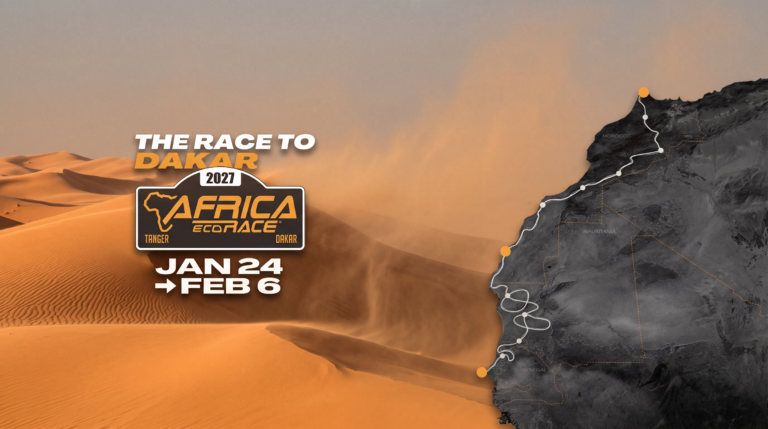
The Dakar Rally’s departure did not mean that rally raid disappeared from Africa. In the disastrous year of 2008 itself, three former winners, Hubert Auriol, Jean-Louis Schlesser, and René Metge, founded the Africa Eco Race, with the express ambition of keeping Sabine’s original spirit alive. The first edition in 2009 still counted only a handful of competitors, but the event grew steadily. The route still runs through Morocco and Mauritania to Senegal, finishing at the legendary Lac Rose. By now the Africa Eco Race, with its seventeenth edition in 2026, has grown into the authentic African alternative, with a starting field of more than two hundred competitors.
Yet the setting of this alternative is not free of tensions either. The route crosses Western Sahara, a former Spanish colony over which a smouldering conflict has been raging for nearly half a century: Morocco controls around eighty percent of it, while the Algeria-backed Polisario Front fights for independence. A UN ceasefire from 1991 held until November 2020, and since then it has been a largely frozen conflict that is tilting increasingly toward Morocco internationally. For rally raid, that tension concentrates at the Guerguerat border crossing, where the Africa Eco Race passes every year. The Polisario Front labels the event complicity with Morocco, has repeatedly issued threats against competitors and press in letters to the UN and online, and has had demonstrators block the passage. The UN stepped in to mediate, including with escorts from the MINURSO mission. So far the caravan has come through each time without any notable incidents.
At world championship level, too, Africa has not entirely vanished. The Rallye du Maroc has been a fixed round of the FIA-FIM World Rally-Raid Championship (W2RC) for years, and from 2026 the new South African Safari Rally will join it. What is missing is precisely what made the classic Dakar Rally so special: the long crossing straight through the Sahara and the Sahel. And that is where the problem lies. The countries that formed the setting of the old Dakar Rally are today largely unreachable. Mali, Burkina Faso, and Niger were hit by coups between 2020 and 2023, left the West African community ECOWAS in January 2025, and are grappling with a growing insurgency by groups such as JNIM and the Sahel Province of Islamic State. In 2025, JNIM even imposed a months-long fuel blockade around the Malian capital Bamako. Where the caravan once passed through is now a conflict zone.
What does the future hold?
Realistically, the classic, trans-Saharan Dakar will not return any time soon. The main reason is the hard geopolitical reality: rally director David Castera was candid in early 2026 that, given the current situation, North Africa is simply no longer possible to enter. On top of that comes the economic side. An event of this scale depends on a host country that bears the costs of logistics, security, and organisation, something the unstable Sahel countries cannot offer. The same consideration had already played a role in the earlier departure from South America, where the governments in fact wanted to pay less.
The contract with Saudi Arabia was extended by five years in 2024 and runs until 2029; according to Castera, there is no plan B beyond that for now. Even so, the organisation itself indicates that the possible routes within the country are beginning to run out, and so new destinations are being sought behind the scenes. According to reporting, including from the Argentine outlet Infobae, the organisation is looking primarily toward Asia, with China as a candidate for the period from 2030 onward. Castera himself tempers that expectation: both the rumours about China and those about a return to South America he calls more a wish of journalists than a concrete plan, and he also points to the harsh Asian winter in January as a practical objection. A return to Africa is, given the current security situation, out of the question in any case.
Within the field of competitors, feelings are mixed. Some top drivers, including multiple winner Carlos Sainz, are content as long as the stages remain challenging. Others, such as Sébastien Loeb, argue precisely for more variety in terrain and countries. What most of them share is a certain nostalgia for the Africa of old, combined with the awareness that those days will not simply come back.
The Dakar Rally as Sabine intended it thus lives on along two tracks. The name and the brand travel through the Arabian desert, where the big money, the factory teams, and the world titles lie. The original spirit, with bivouacs in the open sand and the finish at the pink lake, endures at the Africa Eco Race and on the remaining African world championship rounds. Whether the two ever come together again depends less on the will of the organisation than on the question of whether the Sahel ever becomes safe enough again to send a caravan through it. For now that remains, in Sabine’s words, above all a dream for those who stay behind.

Comments are closed.